Vietnam Visa for US Citizens 2026: 90 days Evisa & Fees
Last update:
US citizens are not exempt from Vietnam’s visa requirement, every American traveler must hold a valid, approved visa before entering the country, with a maximum stay of 90 days per entry.
The most practical option in 2026 is the Vietnam e-visa, applied entirely online through the Vietnam Immigration Department‘s official portal for a government fee of USD 25 (single-entry) or USD 50 (multiple-entry), with standard processing taking 3 to 5 working days.
Key requirements include a US passport valid for at least 6 months, a qualified passport photo, and a declared entry port that must precisely match the physical checkpoint used — whether that is Noi Bai International Airport, Tan Son Nhat International Airport, or another approved crossing.
Travelers with urgent timelines, prior rejection history, or business visa needs are strongly advised to work with an experienced consultancy such as Tan Van Lang, which has handled tens of thousands of US applicant cases since 2003 and provides expert review, expedited processing, and 24/7 support.
Vietnam Visa Consulting Services for Foreigners
Established in 2003, backed by 20+ years of experience – Trusted with over 10,000 successful Vietnam visa consultations.
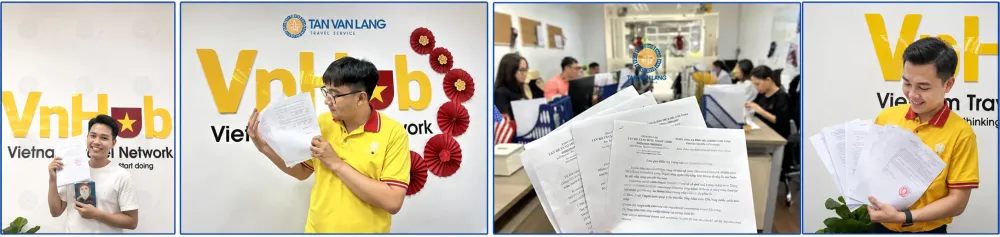
Our Vietnam Visa Consulting Success for Foreign Clients
Vietnam visa for US citizens: Requirements and process
The entry requirements for American passport holders are straightforward once you understand the framework. Every US citizen entering Vietnam must hold a valid, government-approved visa, there are no exceptions for tourism, business, or transit purposes.
The Vietnam Immigration Department is the governing authority for all visa matters, and it maintains strict standards for document accuracy and passport validity. From the practical casework our advisors handle daily, the most common error is not a lack of preparation — it is submitting an application with small but critical mistakes that trigger automatic review or rejection.
Baseline passport requirements
Before any application process begins, your US passport must meet the following minimum conditions:
Validity of at least 6 months beyond your intended arrival date in Vietnam.
At least two blank pages available for immigration stamping.
The passport must be undamaged, unaltered, and machine-readable.
Failing any of these conditions will result in rejection. Immigration officers at Noi Bai International Airport and Tan Son Nhat International Airport enforce these requirements without exception.
Tan Van Lang provides reliable Vietnam visa services backed by over 20 years of professional experience.
Does the United States have a visa exemption with Vietnam?
No. Unlike citizens of certain ASEAN member states or selected European countries that benefit from bilateral visa-free arrangements, American passport holders are not part of any visa exemption agreement with Vietnam [1]. Every US citizen traveling to Vietnam for any purpose (tourism, business, family visits, or otherwise) must hold an approved visa.
As of 2026, the Vietnam Immigration Department has not included the United States in any visa-free framework, and there has been no official government announcement indicating a change in the near future. This reflects the current bilateral immigration structure between the two countries.
The positive development, however, is that the online application system for the Vietnam e-visa is now fully digital, easy to access from the United States, and significantly faster than it was five years ago.
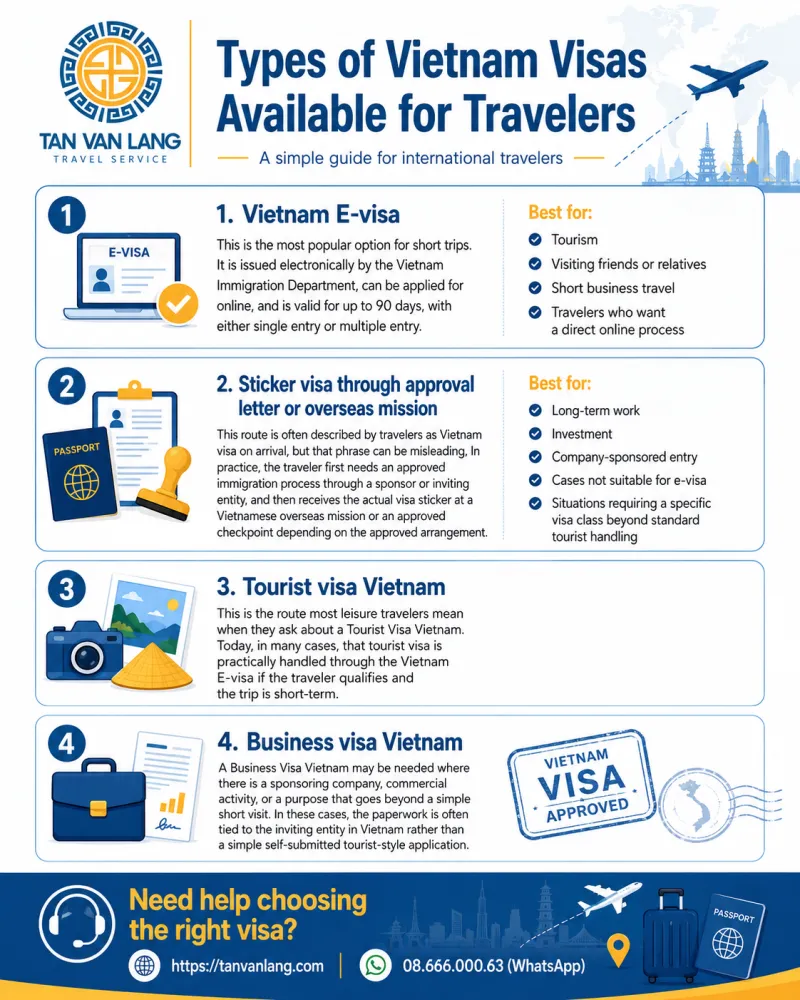
The tourist visa is the most common category for US passport holders visiting Vietnam for vacation, sightseeing, or family reunions. It is valid for up to 90 days and can be structured as a single-entry visa or a multiple-entry visa.
If you plan to visit neighboring countries and return to Vietnam within your stay, the multiple-entry option is the appropriate choice.
Business visa
The business visa covers activities such as attending trade exhibitions, corporate meetings, contract negotiations, and conferences. It carries the same 90-day maximum validity as the tourist visa, and both single-entry and multiple-entry formats are available.
From our advisory practice, US business travelers who visit Vietnam more than once per quarter consistently benefit from the multiple-entry structure.
Vietnam e-visa
The Vietnam e-visa is the preferred route for the vast majority of American applicants in 2026. It is accepted at 33 designated international checkpoints including Noi Bai International Airport (Hanoi), Tan Son Nhat International Airport (Ho Chi Minh City), Da Nang International Airport, and Cam Ranh International Airport, as well as selected seaports and land border crossings.
Visa on arrival
Visa on arrival is frequently misunderstood. You cannot simply arrive at a Vietnamese airport and expect to receive a stamp without prior arrangement. A visa approval letter must be obtained from a licensed immigration service before you board your flight, airlines will check for it.
The stamping fee is paid in cash at the designated immigration counter upon landing. This option is most practical for travelers with urgent, last-minute itineraries.
We support foreigners with accurate consultation and compliant visa solutions for Vietnam.
Based on the case volume we process each year, document errors are the primary cause of e-visa delays and rejections for US applicants. Every item listed below must be prepared carefully and in the correct format before you begin the online application.
Mandatory documents:
A valid US passport with at least 6 months of remaining validity and two blank pages.
A recent digital passport photo: minimum 350×350 pixels, plain white or light-colored background, face fully visible and unobstructed, taken within the past six months.
A clear, high-resolution scanned copy of your passport biographical data page — the page containing your photo and personal details.
Your declared entry port — this must correspond exactly to the physical checkpoint through which you will enter Vietnam. Selecting the wrong port invalidates your e-visa for that location.
Your confirmed intended entry and exit dates.
A valid email address to receive your approved e-visa PDF.
A valid debit or credit card for payment of the government visa fee.
Recommended supporting documents:
Round-trip flight booking confirmation (immigration officers may request proof of onward travel upon arrival).
Hotel reservation or accommodation details for your stay in Vietnam.
An invitation letter from a Vietnamese company — required for business visa applications.
Bank statement or proof of financial stability (occasionally requested for certain business visa categories).
One point that carries serious consequences and is often overlooked: the entry port declared on your e-visa must match the actual border crossing you use. If your e-visa lists Noi Bai International Airport and you land at Tan Son Nhat International Airport instead, the document is invalid at that entry point. This is not a minor technicality, it can result in being denied entry and placed on a return flight at your own expense.
How to apply for a Vietnam e-visa from the United States
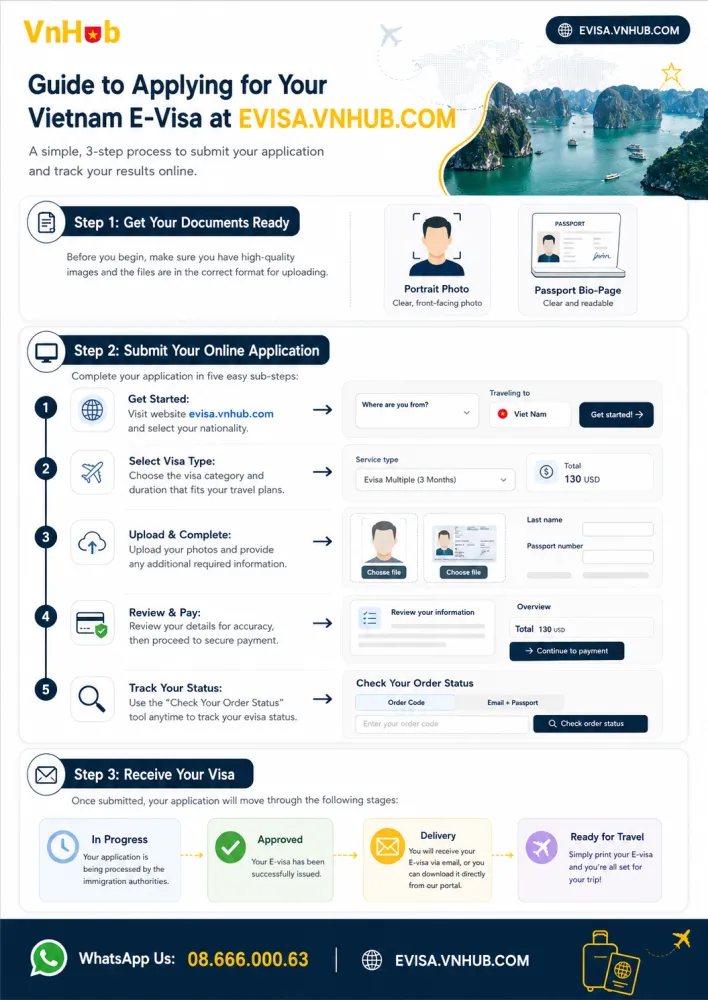
The Vietnam e-visa application involves five clearly defined stages.
Step 1: Access the official portal
Go directly to the official Vietnam Immigration Department portal at evisa.xuatnhapcanh.gov.vn. This is the only legitimate government website for e-visa applications or you can use a trusted visa service provider such as Tan Van Lang via https://evisa.vnhub.com/ to handle the submission on your behalf.
There are a significant number of unofficial third-party websites that mimic the official portal’s design and interface to fraudulently collect application fees and personal data. Always verify the domain name before entering any passport details or payment information.
In our case history, scam sites have caused serious distress for US applicants, including paid fees with no legitimate visa issued and personal data compromised.
Step 2: Complete the online application form
Fill in every field exactly as it appears in your US passport. Do not abbreviate your name, do not transpose digits in your passport number, and do not leave any required field incomplete.
Each data point entered on the form is cross-referenced against your uploaded passport scan during the review process. A single mismatch even a middle name discrepancy or a reversed birth date can trigger rejection without the possibility of fee recovery.
Step 3: Upload your supporting documents
Upload your passport photo and passport bio page scan at this stage. Both files must meet the Vietnam Immigration Department’s specified resolution and format requirements (typically JPG or PNG, under 2MB per file).
A blurred scan, an image with poor contrast, or a photo where the face is partially obscured are among the most frequent technical grounds for rejection.
Step 4: Pay the visa fee
The current official government fees for the Vietnam e-visa are [2]:
E-visa type
Official government fee
Single-entry visa (up to 90 days)
USD 25
Multiple-entry visa (up to 90 days)
USD 50
Payment is completed online via international debit or credit card. Save your payment confirmation receipt, it may be needed if a dispute arises or processing requires follow-up.
Step 5: Await processing and collect your e-visa
Standard processing time is 3 to 5 working days. During Vietnamese public holidays (particularly the Tet Lunar New Year period, National Day, and Liberation Day) processing may extend to 7 working days.
Once approved, your e-visa is delivered as a PDF to the email address registered on your application. Print this document and carry both a physical copy and a saved digital copy on your device. You will be required to present it at check-in and at Vietnamese immigration upon arrival.
Temporary residence registration, a requirement most travelers miss
Once inside Vietnam, all foreign nationals are subject to the temporary residence declaration requirement. If you stay at a licensed hotel or guesthouse, the accommodation provider registers your stay with local authorities on your behalf.
If you stay at a private residence including an Airbnb or with a Vietnamese host, you or your host must register your presence with the local ward police (Công an phường/xã) within 24 hours of arrival. Failure to comply is recorded as an immigration violation and can complicate future visa applications to Vietnam.
The total visa fee depends on both the official government charge and any service fee from a professional consultancy. The table below provides a practical overview for US applicants.
Official government e-visa fees
Visa type
Validity
Entry type
Government fee
E-visa
Up to 90 days
Single-entry
USD 25
E-visa
Up to 90 days
Multiple-entry
USD 50
Full-service fees through Tan Van Lang
Service tier
Processing time
Estimated total (inclusive of government fee)
Standard
5–7 working days
From USD 48 (single-entry)
Expedited
3–4 working days
From USD 65
Urgent
2 working days
From USD 77–105 depending on type
Emergency (VOA letter)
Same-day (select airports)
Contact directly for a quote
Processing time overview
Application type
Typical timeframe
Standard e-visa (self-applied)
3–5 working days
Extended (peak season or holidays)
Up to 7 working days
Expedited (consultant-assisted)
2–3 working days
Emergency VOA (consultant)
Same-day at major airports
The government fee is minimal. What a professional consultancy provides is a layer of human verification that the automated portal cannot replicate.
At Tan Van Lang, every application is manually reviewed by an experienced advisor before submission: Checking for data entry errors, document quality issues, incorrect visa categories, and entry port mismatches. This review stage is why our approval rate is consistently high even for complex cases.
A practical note from our team: Apply at least two full weeks before your departure date. This buffer gives you time to respond to any supplementary requests from the immigration authority without disrupting your travel schedule.
Yes. All US citizens require a valid, government-approved visa to enter Vietnam, regardless of the purpose of their visit. The Vietnam Immigration Department currently maintains no visa exemption agreement with the United States. The Vietnam e-visa is the most accessible option for most American travelers.
What is the easiest way for US citizens to get a Vietnam visa?
The Vietnam e-visa through the official online portal is the most convenient method. The application is completed entirely online, there is no requirement to visit an embassy or consulate in person, and the approved visa is delivered electronically. Using a professional visa service adds an error-checking layer that significantly improves approval certainty.
What documents are needed for a Vietnam e-visa?
At minimum: a valid US passport with at least 6 months of remaining validity, a digital passport photo meeting the immigration department’s specifications, a scanned copy of your passport bio page, your intended entry and exit dates, and your declared entry port. Business visa applicants should also include an invitation letter from their Vietnamese partner company.
How long does Vietnam e-visa processing take for US citizens?
Standard processing time is 3 to 5 working days. During Vietnamese public holidays or peak travel periods, this may extend to 7 working days. Expedited processing through a professional service can reduce the turnaround to 2 to 3 working days.
How much does a Vietnam visa cost for US citizens?
The official government fee is USD 25 for a single-entry visa and USD 50 for a multiple-entry visa, both valid for up to 90 days. When applying through a professional consultancy, an additional service fee applies based on processing speed and support level — typically ranging from USD 48 to USD 105 all-inclusive.
Can US citizens get a visa on arrival in Vietnam?
Yes, but only with a pre-approved visa approval letter obtained before departure. Without this letter, airlines will not allow boarding. The actual visa stamp is issued at the immigration counter at designated airports — including Noi Bai International Airport and Tan Son Nhat International Airport — upon presentation of the letter and payment of a separate stamping fee in cash.
What happens if a US citizen overstays in Vietnam?
Overstaying is a serious violation of Vietnamese immigration law. Based on current regulations, overstayers face monetary fines, a mandatory supervised exit process, and re-entry bans ranging from one to three years depending on the duration of the overstay. In cases of extended overstay, detention during administrative processing is possible. If your plans change and you cannot depart before your visa expires, consult a licensed immigration advisor immediately — before the expiry date, not after.
Tan Van Lang has been the trusted partner of US travelers navigating Vietnam’s immigration requirements for over two decades. Whether your situation is routine or highly complex, our advisors are available around the clock to review your application, provide accurate guidance, and ensure your Vietnam visa for US citizens is approved without error or delay.




![Vietnam Visa Fees & Cost: Updated E-visa, Embassy [Full List]](https://tanvanlang.com/wp-content/uploads/2025/10/vietnam-visa-fees-cost-300x200.webp)