Home » Vietnam Visa » Do US Citizens Need a Vietnam Visa? 2026 Rules Explained
Do US Citizens Need a Vietnam Visa? 2026 Rules Explained
Last update:
US citizens do need a Vietnam visa to enter Vietnam for tourism, business, family visits, or most other travel purposes. The most convenient option is the Vietnam E-visa, issued online by the Vietnam Immigration Department and valid for up to 90 days with single-entry or multiple-entry options.
A US passport does not qualify for Vietnam’s standard 45-day visa exemption, unless the traveler holds a valid 5-year visa exemption certificate, temporary residence card, or meets the separate Phu Quoc visa exemption conditions. To avoid boarding denial or entry issues, American travelers should apply before departure and check all passport, entry date, and port details carefully.
Vietnam Visa Consulting Services for Foreigners
Established in 2003, backed by 20+ years of experience – Trusted with over 10,000 successful Vietnam visa consultations.
Our Vietnam Visa Consulting Success for Foreign Clients
Yes, United States passport holders are required to obtain a valid visa before entering Vietnam, unless they fall under a special exemption category. This applies whether the trip is for tourism, business, visiting relatives, attending events, or exploring investment opportunities.
The question “do US citizens need Vietnam visa” often appears because many Americans can travel visa-free to several countries in Southeast Asia. Vietnam applies its own entry rules, and a US passport alone does not give ordinary visa-free access to mainland Vietnam.
For most American travelers, the current entry path is straightforward: apply for a Vietnam E-visa online, wait for approval, download the visa PDF, print it, and present it upon arrival. For business travelers, sponsored visa approval letters may also be used in certain cases when a Vietnamese company handles the invitation procedure.
Traveler situation
Does a US citizen need a Vietnam visa?
Common solution
US tourist visiting Hanoi, Da Nang, Ho Chi Minh City, Ha Long Bay, or other mainland destinations
Yes
Vietnam E-visa
US business visitor attending meetings or market research
Vietnam E-visa for US citizens: The primary option
The Vietnam E-visa is now the primary and most convenient Vietnam visa for Americans. It is issued electronically through the official Vietnam E-visa system and can be used at approved international airports, land borders, and seaports.
According to the latest visa framework introduced under Law No. 23/2023/QH15 and implemented from August 15, 2023 [1], Vietnam E-visas may be valid for up to 90 days and may be granted for either single entry or multiple entries. This is a major improvement compared with the older 30-day e-visa model.
For US citizens, the e-visa is suitable for most short-term travel purposes, including tourism, family visits, business discussions, conferences, and exploratory commercial trips. It is especially useful for travelers who want to enter Vietnam more than once during the same journey, such as a trip combining Vietnam, Cambodia, Thailand, Singapore, or Laos.
Vietnam E-visa feature
Current rule for US citizens
Maximum validity
Up to 90 days
Entry type
Single entry or multiple entry
Issuing authority
Vietnam Immigration Department
Application method
Online application
Official fee
25 USD for single entry; 50 USD for multiple entry
Refund policy
Normally non-refundable if refused or entered incorrectly
Output
Downloadable electronic visa PDF
The e-visa is not the same as a visa sticker in the passport. It is a digital approval document that must be printed or saved carefully for airline check-in and immigration inspection.
American travelers should not apply through random advertising websites without checking the domain carefully. Scam sites often imitate official language, charge excessive fees, or collect passport data without clear accountability.
For direct self-application, use the official Vietnam E-visa portal operated by the Vietnamese authorities. If you need professional review, urgent support, or correction guidance, Tan Van Lang can help verify the file before submission and reduce the risk of avoidable refusal.
US citizens applying for a Vietnam E-visa should prepare clear digital documents before starting the form. Poor photo quality, cropped passport images, and inconsistent personal information are common reasons for delay or refusal.
The basic required documents usually include a valid US passport, a passport data-page image, a portrait photo, travel information, and an online payment method. The passport should remain valid for at least 6 months beyond the intended entry date, and it should have blank pages for entry and exit stamps.
Document or information
Practical requirement
Expert note from Tan Van Lang
US passport
Valid passport with clear biographical information
Use the same passport for application and travel
Passport validity
At least 6 months is strongly recommended and commonly required by airlines and immigration practice
Renew early if close to expiry
Passport scan/photo
Full data page, no glare, no cropped corners
Avoid shadows and reflections
Portrait photo
Recent, clear, front-facing, neutral background
Do not use selfies with filters
Travel dates
Intended entry and exit dates
Choose dates carefully; visa validity follows the issued approval
Entry and exit port
Airport, land border, or seaport accepted for e-visa use
Confirm your route before applying
Accommodation details
Hotel, residence, or inviting party in Vietnam
Must be realistic and consistent
Payment method
International card or accepted online payment method
Government fee is usually non-refundable
One common issue is name order. US passports often display surname and given names clearly, but applicants sometimes reverse names, omit middle names, or add punctuation that does not match the passport.
Every character matters. The visa should match the US passport exactly, including full name, date of birth, nationality, passport number, and sex.
If the traveler has dual nationality, the application should be based on the passport used to enter Vietnam. A visa issued for one passport cannot automatically be used with another passport.
Step-by-step process to apply for a Vietnam visa online
The online Vietnam E-visa process is simple, but it still requires careful attention. Many refusals or boarding problems happen not because the traveler is ineligible, but because the application was rushed.
Step 1: Access the official Vietnam E-visa portal
Go to the official electronic visa system and choose the foreigner application section. Make sure you are not using a lookalike website with a similar layout or a paid advertising label.
Check the website address before uploading your US passport. Passport data is sensitive, and it should only be submitted through a trusted official portal or a verified visa service provider.
Step 2: Upload the passport data page and portrait photo
Upload a clear image of the passport biographical page. The full page should be visible, including the passport number, name, date of birth, nationality, issue date, expiry date, and machine-readable zone.
Upload a proper portrait photo. The face should be centered, uncovered, and easy to identify.
Step 3: Fill in personal and travel information
Enter your full name, date of birth, nationality, passport number, intended entry date, intended length of stay, address in Vietnam, and port of entry. All details should match your passport and travel plan.
Before paying, review every field slowly. Pay special attention to passport number, date format, spelling, gender, nationality, and entry date.
Once submitted, the government fee is generally non-refundable. If the application contains errors, the traveler may need to submit a new application and pay again.
Step 5: Pay the Vietnam visa fee online
Pay the e-visa fee using the accepted online payment method. The official government fee is 25 USD for a single-entry e-visa and 50 USD for a multiple-entry e-visa.
Keep the application code and payment confirmation. You will need the code to check the result.
Step 6: Check the result and download the visa PDF
After processing, check the result online using the registration code, email, and date of birth if required. Once approved, download the e-visa PDF.
Print at least one copy and save a backup on your phone. At airport check-in, airline staff may ask to see the visa before issuing your boarding pass.
Step 7: Present your visa upon arrival in Vietnam
When you arrive in Vietnam, present your passport and printed e-visa to the immigration officer. The officer will inspect the documents and issue the appropriate entry stamp.
Check the entry stamp before leaving the counter. If the permitted stay does not match your visa or travel plan, ask for clarification immediately.
Tan Van Lang provides reliable Vietnam visa services backed by over 20 years of professional experience.
Vietnam visa fees and processing times for Americans
The official Vietnam E-visa fees are simple: 25 USD for a single-entry e-visa and 50 USD for a multiple-entry e-visa. These are government fees for e-visa processing and are normally not refunded if the application is refused or if incorrect information is submitted.
Processing time is commonly around 3 working days, but travelers should not apply at the last minute. Public holidays, high travel seasons, incomplete data, payment issues, or manual review can extend the timeline.
Visa option
Official fee
Typical use case
Processing note
Single-entry Vietnam E-visa
25 USD
One trip into Vietnam
Suitable for simple vacations
Multiple-entry Vietnam E-visa
50 USD
Leaving and re-entering Vietnam within the visa validity
Based on our 20+ years of practical experience, we advise US travelers to apply at least 7 to 10 working days before departure when possible. For complex routes, group travel, children, or business visitors, earlier preparation is safer.
The processing time shown on official portals should be understood as an administrative estimate, not a guaranteed boarding deadline. If your flight is close, pre-submission review can help identify whether the application has a high risk of correction or delay.
Most US citizens need a visa for Vietnam, but there are several special cases. These exceptions should be understood carefully because they do not apply to every American traveler.
5-year visa exemption for Vietnamese-Americans
The 5-year visa exemption is a special certificate available to eligible overseas Vietnamese and certain family members. Many Vietnamese-Americans use this option when visiting relatives, handling family matters, or returning to Vietnam frequently.
This certificate is not the same as automatic visa-free entry for all US citizens. It must be applied for, approved, and used with the valid passport connected to the certificate.
Travelers should also check the permitted duration of each stay under the certificate. Having a 5-year validity document does not always mean the holder can stay continuously in Vietnam for 5 years.
Phu Quoc visa exemption for US citizens
Phu Quoc has a separate visa exemption policy for foreign passport holders in certain travel conditions. A US citizen may be eligible for up to 30 days without a Vietnam visa if Phu Quoc is the only destination in Vietnam and the traveler meets the entry and exit requirements.
This policy is often misunderstood. If you plan to visit Ho Chi Minh City, Hanoi, Da Nang, Nha Trang, Ha Long, or any mainland destination, you should not rely on the Phu Quoc exemption.
A safe rule is simple: if your itinerary goes beyond Phu Quoc Island, apply for a Vietnam E-visa before travel. Do not assume that a Phu Quoc exemption can be converted into permission to travel across mainland Vietnam.
Temporary residence card holders
A US citizen who already holds a valid Vietnam temporary residence card may not need a separate visa during the card’s validity period. This typically applies to eligible foreign workers, investors, dependents, or other long-term residents.
The traveler should carry both the passport and the valid temporary residence card. If the passport has changed, the card details should be checked carefully before travel.
Diplomatic, official, and other special categories
Special passports, diplomatic arrangements, or government-related travel may follow different rules. These cases should be checked directly with the competent Vietnamese authority or the Consulate of Vietnam in the US before departure.
For ordinary US passport holders, the default assumption remains that a visa is required.
Tan Van Lang provides reliable Vietnam visa services backed by over 20 years of professional experience.
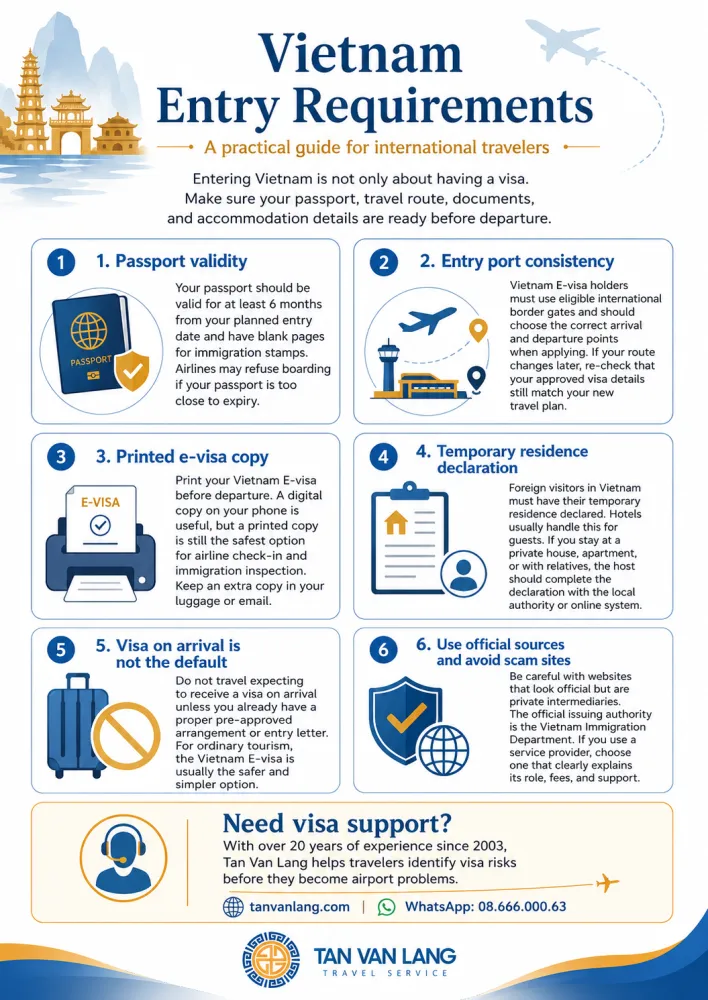
Vietnam entry requirements are not limited to having a visa. US citizens should also prepare for passport validity, entry port consistency, temporary residence declaration, and document presentation.
Passport validity and blank pages
Your US passport should be valid for at least 6 months from the intended entry date. It should also have blank pages for immigration stamps.
Airlines can apply strict document checks before boarding. Even if your visa is approved, a passport close to expiry may create problems at check-in or on arrival.
Entry port and travel route consistency
Vietnam E-visa holders must enter and exit through eligible international border gates. Travelers should choose the correct arrival and departure points during the application.
In practice, many e-visa problems come from route changes after approval. If your flight changes from Da Nang to Ho Chi Minh City or from an airport to a land border, check whether the visa information and port rules still fit your new plan.
Printed e-visa copy
Always print your Vietnam E-visa before departure. A digital copy on your phone is useful as backup, but a printed copy is still the safest option during airline check-in and immigration inspection.
Keep another copy in your luggage or email. Losing access to the PDF during travel can cause unnecessary stress.
Temporary residence declaration in Vietnam
Foreigners staying in Vietnam must have their temporary residence declared according to Vietnamese regulations. In hotels, this is usually handled by the accommodation provider.
If you stay at a private house, apartment, or with relatives, the host should complete the temporary residence declaration with the local authority or through the applicable online system. This is a compliance detail that many tourists never see, but it matters for longer stays, extensions, police checks, or administrative procedures.
Visa on arrival is not the default option anymore
Many older travel blogs still mention Vietnam visa on arrival as if it were available to all tourists. In practice, US citizens should not fly to Vietnam expecting to receive a visa on arrival without a pre-approved entry letter or proper arrangement.
For ordinary tourism, the Vietnam E-visa is the cleaner and safer option. For sponsored business or special cases, a visa approval letter may still be arranged through a qualified sponsor and processed according to the approved place of visa issuance.
Check official sources and avoid scam sites
US travelers should be careful with websites that look official but are private intermediaries. Some are legitimate service providers, but others create confusion by using official-looking names, high service charges, or unclear refund terms.
The official authority behind e-visa issuance is the Vietnam Immigration Department. If you use a service provider, choose one that clearly explains its role, fees, review process, and support scope.
With over 20 years of experience since 2003, Tan Van Lang has handled tens of thousands of complex visa cases involving tourism, business, work, investment, family visits, visa refusals, and urgent travel. Our role is not only to submit forms, but to identify risks before they become airport problems.
American travelers should prepare their Vietnam entry documents early, especially during Tet holiday, summer travel, Christmas, and New Year periods. These are times when flight loads are high and visa support requests increase sharply.
Keep your passport, e-visa, return or onward ticket, hotel booking, travel insurance, and emergency contact details together. Immigration officers may not ask for every item, but having them ready makes entry smoother.
If you are entering for business, carry an invitation letter, meeting schedule, or company contact details when appropriate. A tourist visa may not be suitable if your actual purpose involves employment, paid work, or long-term assignment.
If you plan to stay with relatives, make sure your host understands the temporary residence declaration requirement. This helps avoid problems if you later apply for an extension, residence card, work permit, or other immigration procedure.
For multi-country trips, choose multiple-entry e-visa if you expect to leave and return to Vietnam. A single-entry visa becomes invalid after you exit Vietnam, even if the printed validity period has not expired.
US citizens should not assume they can simply arrive at a Vietnamese airport and obtain a visa without prior approval. Visa on arrival generally requires a valid pre-approved entry letter or an eligible arrangement before departure.For most American tourists, the Vietnam E-visa is the recommended option. It is clearer, online, and suitable for standard travel plans.
How long can a US citizen stay in Vietnam on a tourist visa?
A US citizen using a Vietnam E-visa may receive a validity period of up to 90 days, depending on the approved application. The actual permitted stay follows the dates shown on the issued e-visa and the entry stamp.Do not assume that every visa automatically grants the full 90 days. Always check the “valid from” and “valid until” dates on the approved visa.
Is the Vietnam E-visa valid for multiple entries for US citizens?
Yes, Vietnam E-visas can be issued for single entry or multiple entries. US citizens who plan to leave Vietnam and return during the same trip should select the multiple-entry option.A single-entry e-visa is only valid for one entry. Once you exit Vietnam, it cannot be used again.
Do US citizens need a visa for a short layover in Vietnam?
It depends on whether you pass through immigration. If you stay in the international transit area and do not enter Vietnam, a visa may not be required for a simple airside transit.If you need to collect luggage, change airports, stay overnight outside the transit zone, or enter Vietnam for any reason, you should prepare a valid visa or qualifying exemption before travel.
Can I extend my Vietnam visa while staying in the country?
Whether you can extend your visa depends on your current visa type, your sponsor, and Vietnam’s latest immigration rules. Extensions are not automatic and may change depending on regulations and local practice.If you are already in Vietnam and your visa is close to expiry, contact a professional advisor early. Waiting until the last few days can limit your options.
What is the 5-year visa exemption for US citizens of Vietnamese origin?
The 5-year visa exemption is a certificate for eligible overseas Vietnamese and certain family members. It allows qualified holders to enter Vietnam without applying for a new visa for each eligible visit during the certificate’s validity.It is not automatic for all US citizens. Applicants must meet the eligibility conditions and obtain the certificate before using it for entry.
What should I do if my Vietnam visa application is denied?
First, identify the reason if it is shown or reasonably inferable from the application. Common issues include unclear passport images, incorrect personal information, wrong travel details, unsuitable purpose, or data mismatch.Do not repeatedly resubmit the same incorrect file. Tan Van Lang can review the refused application, identify likely risks, and advise whether to correct and reapply or choose a different visa route.
Conclusion
US citizens do need a Vietnam visa in most cases. The Vietnam E-visa is the most practical route for many American travelers, with up to 90 days of validity and single-entry or multiple-entry options.
The process looks simple, but the details matter. Passport validity, name order, entry port, travel purpose, printed visa copies, temporary residence declaration, and scam-site avoidance can directly affect your ability to board, enter, and stay legally in Vietnam.
If your trip is important, or connected to business, family, work, or long-term plans, let Tan Van Lang review the case before you apply. With more than 20 years of experience since 2003, our team helps US citizens and sponsoring companies prepare the right Vietnam visa solution with confidence.