Home » Vietnam Visa » Single Entry Vietnam Visa 2026: Fees, Validity & How to Apply
Single Entry Vietnam Visa 2026: Fees, Validity & How to Apply
Last update:
A single entry Vietnam visa allows foreign travelers to enter Vietnam one time only during the approved visa validity period. It is suitable for visitors who enter Vietnam once, stay for a fixed trip, and leave without re-entering.
Under current rules, a Vietnam evisa may be valid for up to 90 days and can be issued as single entry or multiple entry, but a single entry visa becomes invalid for re-entry after you exit Vietnam.
Vietnam Visa Consulting Services for Foreigners
Established in 2003, backed by 20+ years of experience – Trusted with over 10,000 successful Vietnam visa consultations.
Our Vietnam Visa Consulting Success for Foreign Clients
A single entry visa for Vietnam, sometimes searched as a 1 entry Vietnam visa or Vietnam visa single use, allows one entry into Vietnam within the visa validity period. After the holder enters Vietnam, stays legally, and exits Vietnam, the visa cannot be used again.
A single entry Vietnam visa does not mean you can stay forever until the visa expires. You must follow the permitted stay, visa validity, entry date, exit date, and conditions printed on the visa document.
In practice, single entry visas are often used for:
One-time tourism trips to Vietnam.
Short business meetings or trade visits.
Family visits without regional travel.
Travelers entering through one airport entry or landport entry point and leaving once.
Applicants who want a lower Vietnam visa fee compared with multiple entry options.
The visa purpose should match the actual entry purpose. A tourist visa DL is generally used for tourism, while a business visa DN may be used for business-related activities where proper sponsorship or documentation is required.
Single entry vs multiple entry Vietnam visa comparison
A single entry visa allows one entry. A multiple entry visa allows the holder to leave and re-enter Vietnam several times during the validity period, provided the visa remains valid and the traveler meets entry conditions.
Based on our advisory experience, many travelers choose a single entry Vietnam visa because they only look at the fee. This is risky if the travel plan includes side trips to Cambodia, Thailand, Laos, Singapore, or another country before returning to Vietnam.
If you are flying into Ho Chi Minh City, leaving for Cambodia through Moc Bai border gate, then returning to Vietnam for a flight home, a single entry visa is not enough. You should consider a multiple entry visa or prepare a second visa before your return.
A single entry Vietnam visa is the right choice when your travel plan is direct and simple. You enter Vietnam once, stay in Vietnam, then leave Vietnam without coming back during the same visa period.
You should consider a single entry visa if:
Your itinerary has only one Vietnam arrival and one Vietnam departure.
You do not plan to visit another country and re-enter Vietnam.
You want to reduce the official Vietnam visa fee.
You are applying for a short tourist visa DL or short visit through the Vietnam evisa system.
You are not sure about regional travel and prefer to finalize a fixed Vietnam-only itinerary.
From our practical experience, single entry is especially suitable for first-time tourists who enter through Tan Son Nhat, Noi Bai, Da Nang, Cam Ranh, or Phu Quoc international airport and leave from one of these airports. It is also suitable for travelers entering by land through a permitted landport entry point such as Moc Bai border gate, Mong Cai border gate, or Lao Cai border gate, provided their visa and port selection are correct.
You should not choose a single entry visa if your schedule includes leaving Vietnam temporarily. This includes a weekend in Bangkok, a business meeting in Singapore, a Cambodia tour from Ho Chi Minh City, or a border run for visa purposes.
Tan Van Lang provides reliable Vietnam visa services backed by over 20 years of professional experience.
Duration and validity periods: 30-day and 90-day options
Vietnam visa validity refers to the period during which the visa can be used for entry, stay, and exit according to the approval. For e-visas, current rules allow a maximum validity of up to 90 days, with either single entry or multiple entry depending on the application and approval.
Common single entry options include:
Option
Typical use
Key note
30 day single entry
Short tourism, meetings, family visits
Lower cost and suitable for fixed short stays
90 day single entry
Longer tourism, extended visit, flexible stay within Vietnam
Still only one entry despite longer validity
A 30 day single entry visa is not the same as a 90 day single entry visa. The number of entries may be the same, but the validity period is different.
The most common misunderstanding is assuming that 90 days means the traveler may leave and return many times. That is only true if the visa is multiple entry. A 90 day single entry visa is still single use.
Applicants should also distinguish between visa validity and actual travel dates. If your e-visa is valid from 1 July to 29 September, you should not attempt to enter before 1 July or stay beyond 29 September unless you have obtained a lawful visa extension, visa renewal, or another approved immigration solution.
For many international travelers, the most practical route is the single entry e-visa Vietnam application. This is submitted online through the official Vietnam evisa portal managed by the immigration authority.
The official government portal is commonly recognized through evisa.xuatnhapcanh.gov.vn or the updated e-visa platform linked from Vietnam immigration channels. Applicants should be careful because many commercial websites use similar wording, national colors, or official-looking designs.
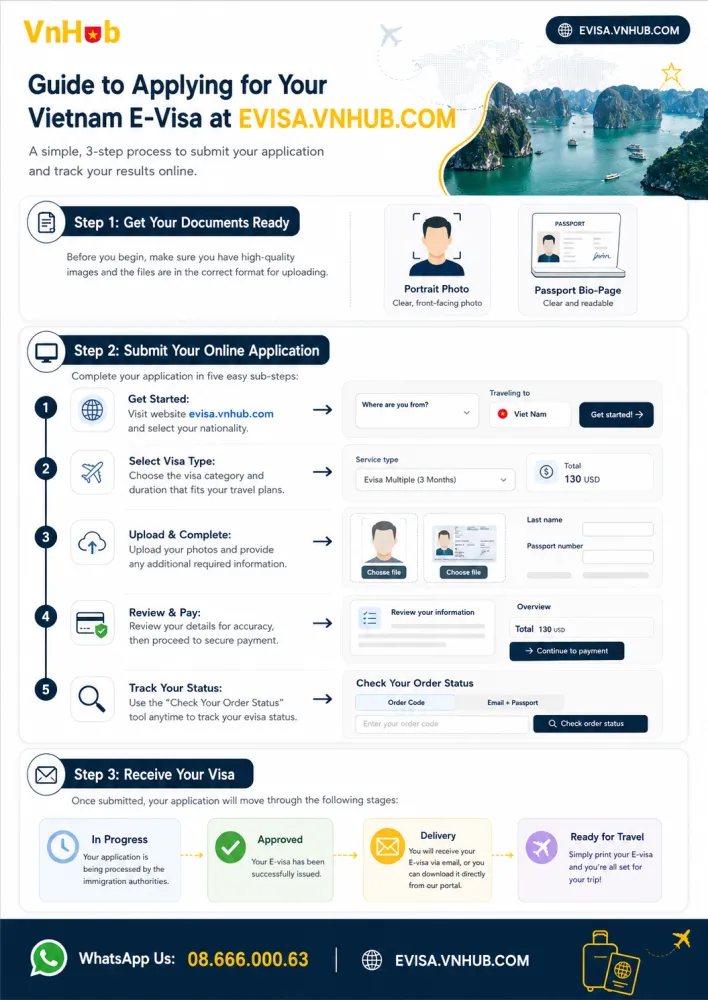
The basic process is:
Access the official Vietnam evisa application page.
Upload a passport data page image and a portrait photo.
Fill in personal information exactly as shown in the passport.
Select visa type, validity period, single entry or multiple entry, and intended port of entry.
Review all information carefully before payment.
Pay the non-refundable e-visa fee.
Save the registration code.
Check application status after the standard processing period.
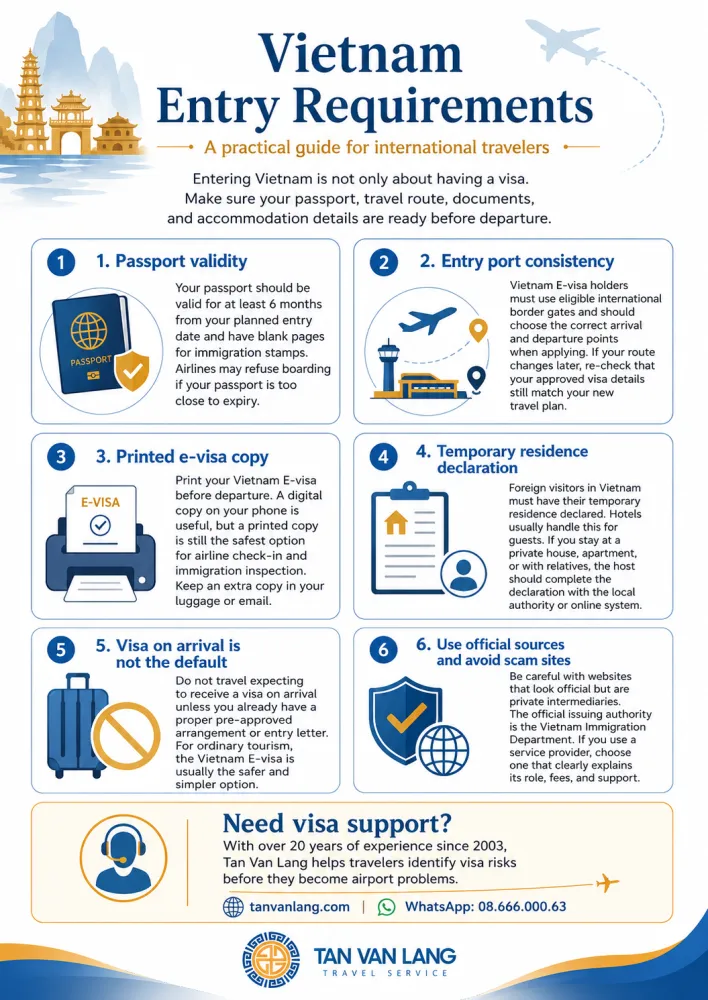
Download and print the approved e-visa before traveling.
From our practical advisory work, the registration code is extremely important. If the applicant loses it, checking the result or correcting follow-up issues can become more difficult.
A single entry e-visa does not normally require a visa stamp at the airport because the visa is issued electronically. However, travelers should still carry a printed copy because airline staff and border officers may request to see it before boarding or at immigration control.
Required documents for a single entry Vietnam visa
The required documents depend on the visa route. For a standard Vietnam evisa, the applicant usually needs clear identity and travel information. For sponsored visas, business visas, or visa on arrival cases, additional paperwork may apply.
For a single entry Vietnam evisa, prepare:
Passport valid for at least 6 months from the intended entry date.
Passport data page image in clear quality.
Recent portrait photo, straight looking, without glasses.
Intended arrival date and exit date.
Intended port of entry and exit.
Accommodation address in Vietnam.
Email address to receive notices or check updates.
International payment card for the e-visa fee.
For certain business visa DN cases, applicants may need:
Sponsoring company information in Vietnam.
Business invitation or supporting documents.
Approval letter issued through competent Vietnamese authorities.
Enterprise registration or related documents from the sponsor.
Explanation of business purpose, working schedule, or meeting plan.
For visa on arrival or sponsored entry routes, the traveler may also need a visa approval letter before departure. At arrival, depending on the route and approval type, the traveler may need to present the approval letter, passport, photos, entry-exit form, and stamping fee to receive a visa stamp.
A common mistake is mixing e-visa rules with visa on arrival rules. A Vietnam evisa is an electronic visa document, while visa on arrival generally depends on a pre-arranged approval letter and visa stamp procedure at designated airports.
The government fee for a Vietnam evisa is generally 25 USD for single entry and 50 USD for multiple entry [1]. This fee is paid online and is not refunded if the application is refused, delayed, abandoned, or submitted with incorrect information.
Item
Typical amount
Notes
Single entry e-visa government fee
25 USD
Paid online to the e-visa system
Multiple entry e-visa government fee
50 USD
Paid online to the e-visa system
Agency service fee
Varies
Charged by visa consultants for checking, support, urgent handling, or case review
Visa stamp fee
Depends on visa route
Relevant mainly for visa stamping routes, not a standard e-visa
Correction or re-application cost
Varies
May apply if wrong passport data, wrong entry type, or wrong date is submitted
Applicants should distinguish between government fees and professional service charges. Government fees are collected by the official system or competent authority. Service fees are charged by agencies for document review, form preparation, urgent support, case assessment, and follow-up.
Standard e-visa processing is commonly stated as 3-5 working days by the official system. In real cases, processing can be affected by weekends, Vietnamese public holidays, peak travel periods, data errors, system issues, or requests for correction.
From our practical experience, applicants should avoid applying too close to the departure date. Airlines may refuse boarding if the traveler cannot show a valid visa, visa exemption eligibility, or other proper entry permission before flying to Vietnam.
A practical timeline is:
Situation
Recommended action
Normal tourist trip
Apply at least 7 to 10 working days before departure
Holiday season or peak travel
Apply earlier to allow for delays
Business trip with fixed meeting date
Prepare documents early and review sponsorship requirements
Urgent departure
Use a professional review and expedited advisory service if available
Previous rejection or data error
Do not simply re-submit without identifying the cause
The most important rule is this: after you leave Vietnam, a single entry Vietnam visa is finished. It cannot be reused for a second airport entry, landport entry, seaport entry, or any other re-entry.
This rule applies even if the visa validity date has not expired. The visa was issued for one entry, not unlimited travel within the date range.
Travelers should check the following before departure:
The full name matches the passport.
Passport number is correct.
Date of birth is correct.
Nationality is correct.
Visa validity covers the intended stay.
Entry type says single entry if only one entry is needed.
Port of entry is suitable for the actual itinerary.
The planned border gate accepts e-visa holders.
Port of entry is a major practical issue. If you apply with airport entry but later decide to enter by land through Moc Bai border gate, Mong Cai border gate, or Lao Cai border gate, your documents may not match the intended route.
For e-visa travel, the selected entry and exit points should match your real travel plan as closely as possible. If your plan changes, seek advice before traveling rather than assuming border officers will accept the change.
Travelers should also remember temporary residence declaration requirements. Hotels usually handle this for guests, but foreigners staying in private homes, rented apartments, or with relatives should make sure the host completes temporary residence registration according to local requirements.
How to convert a single entry visa to multiple entry
In most practical cases, a single entry Vietnam visa cannot simply be “converted” into a multiple entry visa at the airport or border gate. If you need multiple entries, the safer solution is to apply for the correct multiple entry visa before travel.
If your visa has already been issued as single entry and your plan changes, the available options may include:
Applying for a new multiple entry e-visa before entering Vietnam.
Using the current single entry visa for one entry and applying for a new visa before re-entry.
Consulting a visa specialist to assess whether a sponsored visa route is available.
Adjusting the itinerary to avoid leaving Vietnam during the visa validity period.
Inside Vietnam, visa extension or visa renewal options depend on nationality, visa type, sponsor, purpose of stay, immigration policy at the time, and the traveler’s compliance record. They should not be treated as guaranteed.
Based on our advisory experience, the best solution is prevention. If there is any possibility that you will leave Vietnam and come back, choose multiple entry from the beginning.
Common mistakes when applying for a single entry visa
Many single entry visa problems are avoidable. The issue usually begins with a small error in the form but becomes serious at airline check-in, immigration control, or during an urgent re-entry attempt.
Common mistakes include:
Selecting single entry although the itinerary requires multiple entry.
Entering the wrong passport number.
Uploading a blurred passport photo or portrait photo.
Choosing dates that do not cover the full stay.
Confusing 30 day single entry with 90 day single entry.
Applying through scam sites that imitate official portals.
Losing the registration code.
Assuming the e-visa fee is refundable.
Choosing the wrong port of entry.
Trying to re-enter Vietnam after exiting on a single entry visa.
Ignoring temporary residence declaration after arrival.
Waiting until the last day to solve a visa extension issue.
Scam sites are a serious concern. Some websites use official-looking names, Vietnamese symbols, or urgent visa language to collect high fees while offering little accountability.
A professional agency should clearly explain whether it is charging a service fee, what the government fee is, what outcome is realistic, and what information must be accurate. Tan Van Lang always encourages applicants to verify the route, review the data, and keep all visa documents before traveling.
Practical examples from advisory work
A traveler plans to fly from Seoul to Da Nang, stay for 10 days, then fly home. A single entry Vietnam visa is usually sufficient if the traveler is not covered by visa exemption and the visa information matches the passport and flight plan.
Another traveler plans to arrive in Ho Chi Minh City, visit Cambodia through Moc Bai border gate, then return to Vietnam for a flight from Tan Son Nhat. A single entry visa is not suitable because the traveler will need to enter Vietnam twice.
A business visitor plans meetings in Hanoi, then needs to fly to Singapore for one day and come back to Ho Chi Minh City. In that case, a multiple entry visa or a carefully planned second visa is the safer choice.
A tourist receives a 90 day single entry e-visa and assumes it allows regional travel. This is incorrect. The 90-day period gives longer validity, but the single entry condition still limits the visa to one entry only.
When Tan Van Lang should review your case
Every traveler’s case can be different — and choosing the wrong visa type, entry option, or immigration procedure may affect your travel plans, length of stay, or future applications. Getting proper guidance before applying can help you avoid unnecessary issues and prepare the right documents from the beginning.
You should contact Tan Van Lang before applying if:
You are unsure whether to choose a single-entry or multiple-entry visa.
You need detailed advice on how to apply for a Vietnam e-visa correctly.
You need guidance on choosing the most suitable and lawful entry procedure for your situation.
You want to understand the available options for visa extension or visa renewal in Vietnam.
With over 20 years of experience since 2003, Tan Van Lang has supported foreign tourists, businesses, families, investors, and long-term visitors with both straightforward and complex Vietnam visa and immigration cases. Our team can review your situation, explain the available options, and help you prepare the most appropriate application based on current immigration regulations.
For a smoother and safer application process, you can contact Tan Van Lang for personalized support before submitting your Vietnam e-visa application.
Frequently asked questions
What does single entry Vietnam visa mean?
A single entry Vietnam visa means you may enter Vietnam one time during the approved visa validity period. After you exit Vietnam, the visa cannot be used again.It is also called a 1 entry Vietnam visa or Vietnam visa single use. The key point is the number of entries, not only the expiry date.
How long is a single entry Vietnam visa valid?
A single entry Vietnam visa may be issued for different validity periods depending on the visa type and approval. For Vietnam evisa, current rules allow validity of up to 90 days.Common options include 30 day single entry and 90 day single entry. Even with 90 days of validity, the visa still allows only one entry if it is issued as single entry.
Can I leave and re-enter Vietnam with a single entry visa?
No. Once you leave Vietnam, your single entry visa is considered used.If you want to re-enter Vietnam, you need a new visa, visa exemption eligibility, or another valid entry permission. If your trip includes regional travel, a multiple entry visa is usually safer.
How much does a single entry Vietnam e-visa cost?
The standard government fee for a single entry Vietnam e-visa is 25 USD. A multiple entry e-visa is generally 50 USD.These are government fees. If you use a visa agency such as Tan Van Lang, a separate service fee may apply for consultation, application review, urgent support, or case handling.
What is the difference between single and multiple entry Vietnam visas?
A single entry visa allows one entry into Vietnam. A multiple entry visa allows the holder to leave and re-enter Vietnam multiple times while the visa remains valid.The best choice depends on your itinerary. If Vietnam is your only destination, single entry may be enough. If you will visit another country and return to Vietnam, multiple entry is usually the correct option.
Can I extend a single entry Vietnam visa inside the country?
Visa extension or visa renewal may be possible in some cases, but it is not guaranteed. It depends on nationality, visa type, sponsor, purpose of stay, immigration policy, and the traveler’s compliance history.Do not wait until the last day of your visa validity. Contact a qualified visa advisor early to avoid overstay penalty or emergency travel disruption.
Is a single entry visa cheaper than a multiple entry visa?
Yes, for Vietnam evisa government fees, single entry is generally cheaper than multiple entry. The common e-visa fee is 25 USD for single entry and 50 USD for multiple entry.However, cheaper is not always better. If your itinerary requires re-entry, choosing single entry may lead to new application costs, missed flights, denied boarding, or urgent service fees.