Home » Vietnam Visa » Do I Need a Visa for Vietnam? Check by Nationality (2026)
Do I Need a Visa for Vietnam? Check by Nationality (2026)
Last update:
If you are asking “Vietnam, do I need a visa?”, the answer depends on your nationality, length of stay, and purpose of travel. If you are not eligible for Vietnam visa exemption, you will usually need a visa, and for most short trips, the Vietnam E-visa is now the simplest and most practical option.
Some nationalities can enter Vietnam visa-free for up to 45 days, while longer stays or sponsored purposes such as work or business may require an approval letter and a sticker visa. To answer this keyword accurately, travelers should always check their visa-free eligibility and the right visa type before departure.
Vietnam visa exemption policy for foreign citizens
The first step is to check whether you qualify under Vietnam visa exemption rules. Vietnam currently grants unilateral visa-free entry of up to 45 days to citizens of 13 countries: Germany, France, Italy, Spain, the United Kingdom, Russia, Japan, South Korea, Denmark, Sweden, Norway, Finland, and Belarus.
Because these policies are not identical and can be time-bound, travelers should not assume that a past exemption still applies on the date of entry.
Here is the practical rule:
Nationality group
Visa needed for short visit?
Typical stay allowed
Citizens covered by current unilateral exemption
Not for qualifying short stays
Up to 45 days
Citizens not covered by exemption
Yes
Depends on visa type
Travelers with long-term work, investment, or sponsored purpose
Usually yes
Depends on approval and visa class
A critical detail most applicants overlook is that visa-free entry is not the same as unlimited entry freedom. You still must satisfy passport validity, entry conditions, and any other border requirements in force on the day you arrive.
Do US citizens need a visa for Vietnam?
In most ordinary cases, US citizens do need a visa to visit Vietnam. The practical route is usually the Vietnam E-visa, unless the trip requires a sponsored visa structure or another category outside the self-application flow. Vietnam’s e-visa is available to foreign citizens broadly, including Americans, and is valid for up to 90 days.
Do UK citizens need a visa for Vietnam?
For many short trips, UK citizens may enter visa-free for up to 45 days under Vietnam’s unilateral exemption policy. If the intended stay is longer, or the entry purpose does not fit the exemption conditions, a visa is still required.
Do Australians need a visa for Vietnam?
In standard travel scenarios, Australians do need a visa unless they fall under another valid exemption category. The e-visa is generally the most straightforward option for tourism and short business travel.
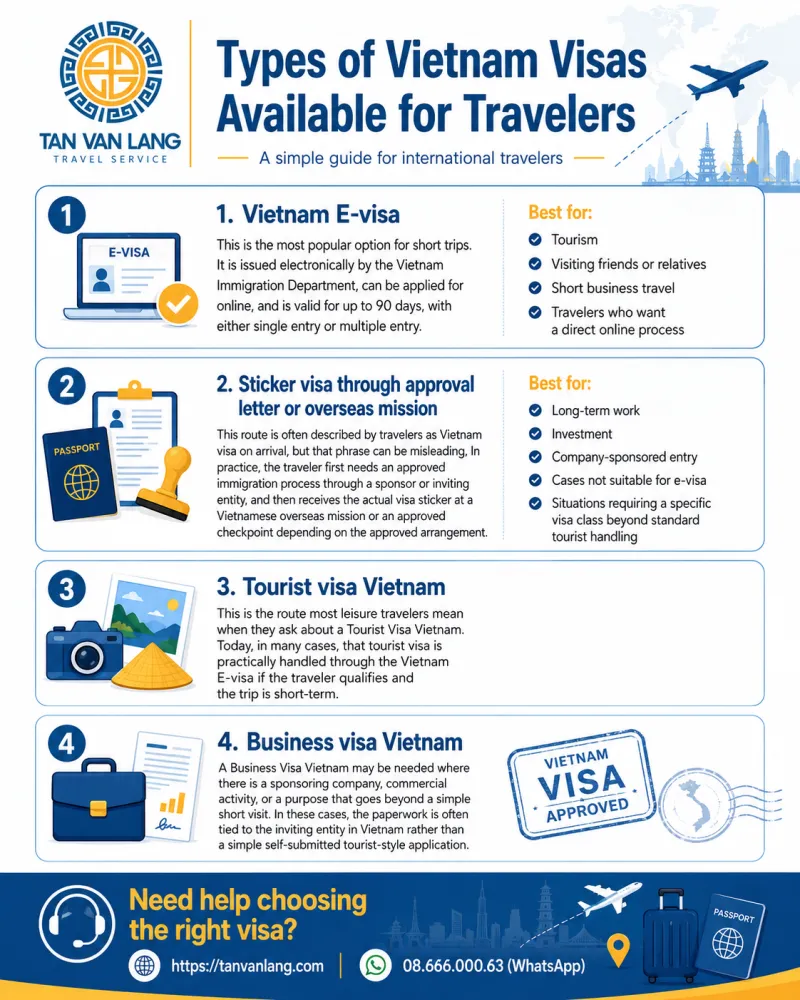
If you are not visa-exempt, the next question is not just whether you need a visa, but which visa route is appropriate. Based on our daily advisory work, the main routes travelers ask about are the following.
1. Vietnam E-visa
This is the most popular option for short trips. It is issued electronically by the Vietnam Immigration Department, can be applied for online, and is valid for up to 90 days, with either single entry or multiple entry.
Best for:
Tourism
Visiting friends or relatives
Short business travel
Travelers who want a direct online process
2. Sticker visa through approval letter or overseas mission
This route is often described by travelers as Vietnam visa on arrival, but that phrase can be misleading. In practice, the traveler first needs an approved immigration process through a sponsor or inviting entity, and then receives the actual visa sticker at a Vietnamese overseas mission or an approved checkpoint depending on the approved arrangement.
Best for:
Long-term work
Investment
Company-sponsored entry
Cases not suitable for e-visa
Situations requiring a specific visa class beyond standard tourist handling
3. Tourist visa Vietnam
This is the route most leisure travelers mean when they ask about a Tourist Visa Vietnam. Today, in many cases, that tourist visa is practically handled through the Vietnam E-visa if the traveler qualifies and the trip is short-term.
4. Business visa Vietnam
A Business Visa Vietnam may be needed where there is a sponsoring company, commercial activity, or a purpose that goes beyond a simple short visit. In these cases, the paperwork is often tied to the inviting entity in Vietnam rather than a simple self-submitted tourist-style application.
For most travelers asking “Vietnam do I need a visa?”, this is the section that matters most. The official Vietnam e-visa system is operated by the Immigration Department, and since November 11, 2024, the official portals are evisa.gov.vn. Using the correct government portal matters because scam or imitation sites remain one of the biggest reasons travelers overpay or receive bad guidance.
Official Vietnam e-visa process
The official system states that applicants should:
Upload the passport data page image and portrait photo.
Pay the government e-visa fee online.
Track the application using the registration code, email, and date of birth.
Print the approved e-visa for entry and exit.
Required digital documents
According to the official instructions, the core documents and inputs normally include:
Valid passport data page image
Portrait photo looking straight ahead, without glasses
Intended date of entry and exit
Intended entry checkpoint and exit checkpoint
Temporary residential address in Vietnam
Email address for receiving the registration code and updates
Standard processing time
The official e-visa instruction states that, after payment, the application is processed in 3 working days. In real practice, travelers should apply earlier than that because any typo, mismatch, photo issue, or unclear travel detail can delay approval.
Practical expert advice
From our real case handling, these are the most common e-visa mistakes:
Wrong passport number
Wrong date of birth format
Uploading a poor passport scan
Choosing the wrong Vietnam international airports or border gate
Entering a vague hotel address
Waiting until the last few days before departure
A critical detail most applicants overlook is that the entry checkpoint on the application must match an approved checkpoint for e-visa use. Official FAQs also clarify that e-visa holders are not required to exit through the same border gate where they entered, but they still must use an approved entry/exit checkpoint listed for e-visa holders.
Tan Van Lang provides reliable Vietnam visa services backed by over 20 years of professional experience.
The term Vietnam visa on arrival is still widely used online, but travelers should understand it correctly. Vietnam does not operate as a casual “show up and get a visa without prior approval” system for ordinary travelers. What usually happens is a two-stage process involving prior approval and then visa issuance at the designated place.
How the process works in practice
Step
What happens
1
A sponsor, inviting person, or organization in Vietnam submits the immigration request
2
The dossier is reviewed by the competent authority
3
If approved, the result is issued for the traveler’s visa procedure
4
The traveler receives the visa sticker at the approved overseas mission or checkpoint arrangement
Official Immigration Department guidance shows that organizations can submit invitation and sponsorship data through the electronic system, track dossier status, and download the response or related documents once processed.
Who usually needs this route?
This route is more relevant where:
There is a company sponsor in Vietnam
The purpose involves work, investment, family matters, or another non-simple travel purpose
The traveler cannot or should not use an e-visa
The approved visa class requires formal invitation or guarantee
Based on our 20+ years of practical experience, many travelers lose time because they use the phrase “VOA” without understanding whether their actual case is a tourism e-visa case or a sponsorship case. The right route depends on the legal purpose of entry, not just the traveler’s preference.
Whether you apply for a Vietnam E-visa or a sponsored visa, you should prepare the file carefully. Border problems are often caused by incomplete or inconsistent details rather than by the visa category itself.
Basic documents for most cases
Document
Why it matters
Valid passport
Core identity and travel document
Passport data page scan
Required for online e-visa filing
Portrait photo
Required for the application record
Travel details
Entry date, exit date, and checkpoint
Temporary address in Vietnam
Required in the application
Payment card
Needed for online government fee
Sponsorship papers if applicable
Needed for company- or person-sponsored entry
The official system requires a valid passport and confirms that e-visa applicants must be outside Vietnam at the time of application. The system also warns that incomplete or incorrect information may lead to refusal or non-acceptance.
Passport validity for Vietnam
As a practical rule, travelers should make sure the passport remains valid at least one month beyond the arrival date, and that is also the standard compliance benchmark we advise clients to meet before travel to avoid airline check-in or border difficulty.
Even where the visa system itself focuses on “valid passport” language, airlines and border officers examine the real travel window. For that reason, we recommend not treating a barely valid passport as safe planning.
We support foreigners with accurate consultation and compliant visa solutions for Vietnam.
One of the most searched topics is Vietnam visa cost. For e-visa cases, the official government fee is straightforward [1].
Official e-visa government fee
According to the official e-visa portal:
E-visa type
Government fee
Single-entry e-visa
USD 25
Multiple-entry e-visa
USD 50
The official system also states that the e-visa fee is non-refundable if the application is refused.
Processing time
Service stage
Estimated time
Standard official e-visa processing
3-5 working days
Practical safe planning window
Earlier than 1 week recommended
Sponsored or sticker visa timing
Case-dependent
The official e-visa instruction says 3-5 working days after payment. In real operations, travelers should allow more time because corrections, public holidays, system load, or sponsor-side delays can affect the final outcome.
About service fees
If you use a consultant or visa agency, that service fee is separate from the government administrative fee. This is where many applicants get confused when comparing prices on the internet.
A critical detail most applicants overlook is that a very low advertised price may exclude correction support, urgent handling, airport procedures, or sponsor-side paperwork. That is one reason experienced case review still matters.
Important entry and exit regulations for foreigners
Getting the visa approved is only one part of a successful trip. The second part is clearing entry smoothly and staying compliant after arrival.
1. Use the official portal only
The Immigration Department announced that the official e-visa portals are evisa.gov.vn and thithucdientu.gov.vn. If a site looks like a government portal but charges unclear extra fees or does not clearly identify the official authority, travelers should be cautious.
2. Check the entry port carefully
Your visa data must align with the intended border route. Official FAQs confirm that entry and exit must be through approved checkpoints for e-visa holders. They also clarify that exit does not have to be through the same gate used for entry.
3. Temporary residence declaration matters
From our daily work with entry compliance issues, this is one of the most overlooked obligations. The official system states that after entering Vietnam, a foreigner must work through the accommodation operator or direct manager to declare temporary residence in accordance with the law.
In practice:
Hotels usually handle this automatically
Private apartments or house stays may require more attention
If you change accommodation, the declaration duty may arise again
4. Watch for airport-specific pre-arrival procedures
As of April 15, 2026, Vietnam Airlines states that foreign passengers entering Vietnam via Tan Son Nhat International Airport are required to complete an entry declaration online through the designated pre-arrival system or QR code. This is an airport-specific operational requirement and should be checked again before travel in case the procedure expands or changes.
5. Health declarations are not the same as older COVID rules
Government reporting in 2022 said Vietnam had already suspended mandatory health declaration rules for foreign arrivals in the earlier COVID context. That should not be confused with newer immigration or airport data collection procedures that may apply operationally at specific airports.
6. Vietnam visa extension is not automatic
Travelers often search for Vietnam visa extension after arriving. The official e-visa portal notes that e-visa holders already in Vietnam may be considered for a new visa if they are invited or guaranteed by an authority, organization, or individual in Vietnam in accordance with the law. That means extension or in-country handling is not a simple guaranteed self-service right.
Based on our case experience, travelers should plan the correct visa duration from the start whenever possible. Relying on a last-minute extension strategy is risky.
US passport holders generally need a visa for ordinary travel to Vietnam. The Vietnam E-visa is usually the simplest route for tourism and short business trips, while company-sponsored or long-term purposes may require a different sponsored process.
Vietnam visa for UK citizens
UK citizens benefit from the current unilateral visa exemption of up to 45 days for qualifying entries. For longer stays or different legal purposes, a visa is still required.
Vietnam visa for Australians
Australian citizens typically need a visa and often use the e-visa route for standard travel. The same checkpoint, timing, and document accuracy rules apply.
We usually advise travelers not to treat the published processing time as their real planning deadline. The official system may say 3 working days, but a professionally safe timeline is longer because airline boarding, travel schedule changes, or document corrections can create avoidable stress.
A sensible planning window is:
At least 1 to 2 weeks before departure for a normal e-visa case
Earlier if travel is during a holiday peak
Earlier still if the case involves sponsorship, unusual nationality-specific concerns, or supporting documents
Frequently asked questions
1. How long can I stay in Vietnam without a visa under the exemption policy?
If you are covered by the current unilateral visa exemption policy, the allowed stay is generally up to 45 days. Always verify whether your nationality is still covered on the date of travel and whether your entry purpose fits the exemption conditions.
2. Is the Vietnam E-visa valid for entry through land borders and seaports?
Yes, the official e-visa system provides a list of approved ports for e-visa entry and exit. The key rule is not whether the route is air, land, or sea in general, but whether it is an approved checkpoint for e-visa use.
3. Can I extend my tourist visa while I am currently inside Vietnam?
You should not assume a simple automatic extension. The official portal says e-visa holders in Vietnam may be considered for a new visa if invited or guaranteed by a Vietnamese authority, organization, or individual under the law.
4. What is the minimum passport validity required to enter Vietnam?
The safest and widely applied rule is to keep your passport valid for at least six months beyond the arrival date. This remains the practical compliance standard we recommend to avoid boarding and entry issues.
5. Do I need a visa if I am only transiting through a Vietnam airport?
That depends on whether you remain airside, the airport procedure, the airline’s rules, and whether you need to pass immigration. Transit cases should never be assumed safe without checking the itinerary structure and carrier requirements. For any transit that may involve immigration clearance, visa review is necessary.
6. How many days in advance should I submit my Vietnam visa application?
Although the official e-visa processing time is 3 working days after payment, we recommend applying at least 1 to 2 weeks in advance where possible. That gives room for corrections and avoids last-minute disruption.
7. Can I convert a Tourist Visa to a Business Visa without leaving the country?
This is case-specific and should not be assumed. The legal basis, sponsoring entity, immigration status, and current visa record all matter, so travelers should get a professional case review before making plans around an in-country conversion.
Conclusion
If your question is simply “Vietnam do I need a visa?”, here is the direct answer: many travelers do, some travelers do not, and the right conclusion depends on nationality, length of stay, and legal purpose of entry. For most non-exempt travelers on short trips, the Vietnam E-visa is the fastest and most practical route. For longer, more specialized, or sponsored cases, the correct answer may be a formal approval-and-sticker process instead.
Based on more than two decades of real visa handling since 2003, Tan Van Lang helps foreign travelers avoid the mistakes that cause refusals, boarding issues, and border delays. If you want your case checked properly before you apply, contact Tan Van Lang for a professional review of your nationality, travel purpose, visa type, and entry plan.