Vietnam travel requirements include a valid passport, the right Vietnam visa or visa exemption, compliant entry purpose, approved entry port, accommodation information, and customs compliance. Most tourists can consider E-visa Vietnam for up to 90 days, while eligible nationalities may use Vietnam visa exemption for up to 45 days or other durations depending on agreements.
Travelers should check passport validity, visa details, health and insurance readiness, temporary residence declaration, and cash declaration limits before departure.
Vietnam is open to international tourists, business visitors, family visitors, investors, and foreign workers, but each group must enter with a document that matches the purpose of travel. For tourism, the common options are Vietnam visa exemption, E-visa Vietnam, embassy visa, or in limited cases a Vietnam visa on arrival arranged through an approval letter.
According to the latest regulations introduced under Law No. 23/2023/QH15 and related implementation guidance, Vietnam has expanded visa flexibility for foreign visitors. The most important change is that electronic visas may be issued for up to 90 days and may be single-entry or multiple-entry, depending on the application and approval.
For international tourists, this creates a more convenient travel environment. A visitor can plan a short vacation, a multi-city itinerary, or a longer stay in Vietnam without immediately needing a local sponsor in many tourist cases.
However, “open” does not mean “uncontrolled.” Vietnam immigration officers still check whether the visitor has a valid passport, a valid Vietnam visa or exemption basis, the right travel purpose, and lawful entry conditions.
From our practical experience, most problems occur before the traveler even reaches immigration. Airlines may deny boarding if the traveler’s passport is damaged, the visa information does not match the passport, the e-visa has not been issued, or the port of entry is not accepted for the e-visa route.
Quick checklist of Vietnam travel requirements
Requirement
What travelers should prepare
Consultant’s note
Passport
Valid passport, normally with at least 6 months of remaining validity and blank pages
Check the passport number and expiry date before applying for any Vietnam visa
Vietnam passport requirements for foreign travelers are straightforward but must be taken seriously. Your passport should be valid for at least 6 months from the date of entry and should have blank pages for entry stamps or visa stickers where applicable.
Some airlines apply strict document screening at departure airports. Even if a traveler believes Vietnam immigration may accept the passport, the airline may refuse boarding if the passport has insufficient validity, serious damage, missing pages, or inconsistent personal information.
Based on our advisory experience, travelers should check these items at least 2 to 4 weeks before departure:
Passport validity of at least 6 months from the intended entry date.
Passport number matching the Vietnam visa or E-visa Vietnam approval.
Full name, date of birth, nationality, and gender matching exactly across documents.
At least one or two blank passport pages.
Return ticket, onward ticket, or clear travel itinerary.
Accommodation booking, hotel confirmation, or host address in Vietnam.
Valid visa, visa exemption basis, temporary residence card, or 5-year visa exemption certificate.
A common mistake is applying for an e-visa using an old passport number. If the traveler later renews the passport, the issued e-visa normally does not automatically transfer to the new passport.
Another frequent issue is name order. Some travelers enter their given name and surname incorrectly on the e-visa application. Immigration officers compare the e-visa against the passport, not against the traveler’s explanation at the counter.
For children traveling to Vietnam, each child should have a valid passport or accepted travel document. If a child travels with one parent, a guardian, or a group, the family should carry supporting documents such as birth certificate, consent letter, or custody documents where relevant, especially for airline screening and border questions.
Tan Van Lang provides reliable Vietnam visa services backed by over 20 years of professional experience.
Vietnam visa policy depends on nationality, passport type, travel purpose, and the intended length of stay. Some visitors may enter without a visa under Vietnam visa exemption, while others must apply for a Vietnam tourist visa, E-visa Vietnam, or another appropriate visa type.
The 45-day unilateral visa exemption is one of the most important Vietnam travel requirements for many tourists. It allows eligible passport holders to enter Vietnam without a visa for a limited stay, provided they satisfy entry conditions [1].
Common visa-free entry categories
Category
Typical stay duration
Who may use it
Important note
Unilateral visa exemption
Up to 45 days
Eligible nationalities under Vietnam’s unilateral exemption policy
Tourism and short stays are common uses
Bilateral visa exemption
Usually 14, 15, 30, or up to 90 days depending on agreement
Nationals of countries with bilateral agreements with Vietnam
Duration varies by nationality and agreement
5-year visa exemption certificate
Multiple entries during certificate validity, with permitted stay per entry
Overseas Vietnamese and eligible family members
Not the same as a tourist e-visa
Phu Quoc special exemption
Limited to eligible direct Phu Quoc travel conditions
International visitors entering Phu Quoc under specific conditions
Travel beyond Phu Quoc may require a visa
Vietnam has also introduced tourism stimulus visa exemption policies for additional European nationalities during specific policy periods. Because these lists and effective dates can change, travelers should verify the exemption status close to the departure date instead of relying on old blog posts or screenshots.
From our practical advisory work, a visa exemption is convenient but not always the best option. If a traveler plans to stay longer than the exemption period, leave and re-enter Vietnam, or combine tourism with business meetings, an E-visa Vietnam or another proper visa route may be safer.
When you should apply for a Vietnam visa instead of relying on exemption
You should consider applying for a Vietnam visa if:
Your nationality is not eligible for visa-free entry.
Your planned stay exceeds the exemption duration.
You need multiple entries into Vietnam.
You will attend business meetings, perform commercial activities, or work with a Vietnamese entity.
You are unsure whether your passport type qualifies for exemption.
You have previously overstayed or had immigration issues in Vietnam.
A tourist visa should not be used for employment, paid work, long-term business operation, or investment management. If the real purpose is work, business, investment, study, or family residence, the visa type must be selected carefully.
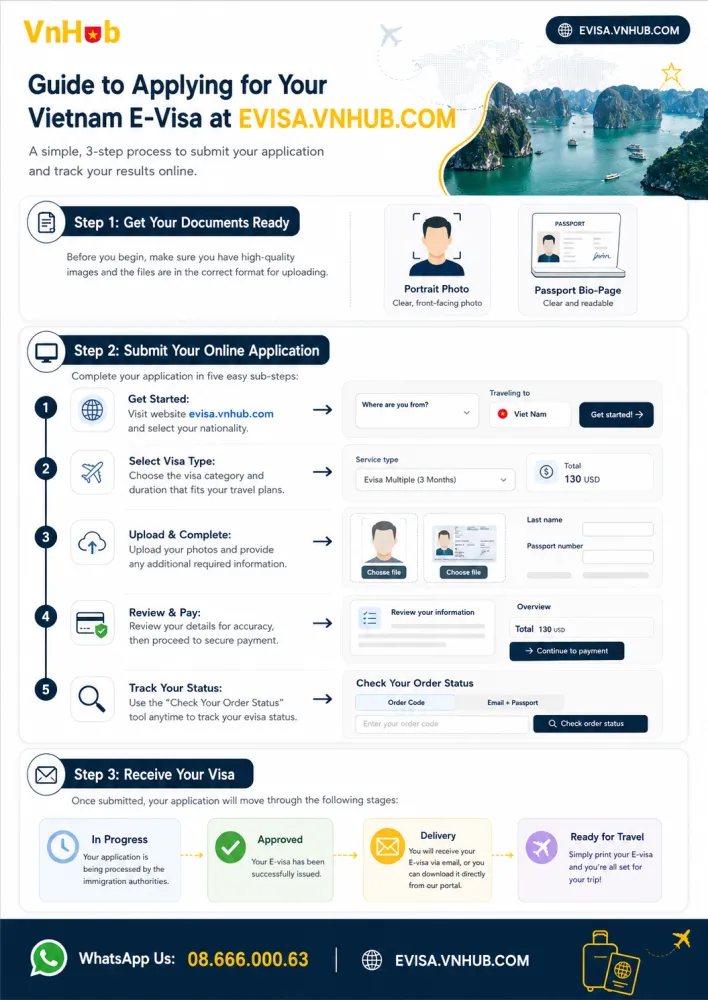
E-visa Vietnam is now the most practical option for many international tourists because it can be applied for online through the official Vietnam electronic visa system. The official portals are evisa.gov.vn and thithucdientu.gov.vn or you can use a trusted visa service provider such as Tan Van Lang via https://evisa.vnhub.com/ to handle the submission on your behalf.
Travelers should be cautious with lookalike websites. Some commercial websites use similar names, paid ads, and urgent language that may confuse applicants into thinking they are on an official government portal.
Using a service provider is not wrong if the traveler wants professional checking or urgent support. The risk appears when a website pretends to be the official government portal while charging unclear service fees.
Vietnam e-visa validity, fee, and processing time
Item
Current rule or practice
Consultant’s note
Maximum validity
Up to 90 days
The final validity depends on the approval granted
Entry type
Single-entry or multiple-entry
Select the correct option at application stage
Government fee
USD 25 for single-entry e-visa, USD 50 for multiple-entry e-visa
Fees are generally non-refundable
Processing time
Usually 3 working days on the official portal
Apply earlier because holidays, corrections, or high-volume periods may cause delays
Required uploads
Passport data page and portrait photo
Photos must be clear and meet portal requirements
Entry and exit ports
Must use approved international border gates for e-visa
Check the approved list before booking complex routes
Step-by-step e-visa application process
Step 1: Prepare your passport and digital photo.
Your passport data page must be clear, complete, and readable. Your portrait photo should show your face clearly, normally without glasses, hats, shadows, or heavy editing.
Step 2: Access the official e-visa portal.
Use evisa.gov.vn or thithucdientu.gov.vn. Avoid applying through random ads without checking whether the website is official or a private service provider.
Step 3: Enter personal information exactly as shown in the passport.
The passport number, full name, nationality, date of birth, sex, passport issue date, and passport expiry date must be accurate. Even one incorrect digit can create problems.
Step 4: Select the visa type and travel dates.
Choose single-entry or multiple-entry carefully. Select the intended validity period based on your itinerary, not only the arrival date.
Step 5: Select your entry and exit ports.
Foreigners using e-visas must enter and exit through border gates approved for e-visa use. These may include Vietnam international airports, land border gates, and seaports on the official list.
Step 6: Pay the visa fee.
The official fee is typically USD 25 for a single-entry e-visa and USD 50 for a multiple-entry e-visa [2]. Keep your registration code because you need it to check the result.
Step 7: Check the result and download the e-visa.
After approval, download the e-visa and print a copy. Also keep a digital copy on your phone, but do not rely only on your phone battery at the airport.
Entry port consistency and why it matters
Vietnam’s e-visa system is more flexible than the old process, but travelers must still follow approved entry and exit checkpoints. If your e-visa or itinerary involves a specific international airport, land border, or seaport, make sure your actual travel route is compatible.
From our practical experience, issues often arise when travelers change from Tan Son Nhat International Airport to a land border, or from a planned airport to a seaport itinerary, without checking the approved e-visa checkpoint list. A cheap flight change can become expensive if it creates an immigration mismatch.
Major Vietnam international airports commonly used by tourists include Noi Bai International Airport in Hanoi, Tan Son Nhat International Airport in Ho Chi Minh City, Da Nang International Airport, Cam Ranh International Airport, Phu Quoc International Airport, Cat Bi International Airport, Can Tho International Airport, Phu Bai International Airport, and Van Don International Airport. Travelers should still confirm the official list before departure because checkpoint policy may be updated.
Vietnam visa on arrival is often misunderstood. It does not mean a traveler can simply arrive at the airport with no pre-approval and request a visa at the counter.
In practice, visa on arrival usually requires an approval letter arranged before departure through a qualified sponsoring or arranging party. The traveler then receives the visa stamp at an eligible international airport after presenting documents and paying the stamping fee where applicable.
For many tourists, E-visa Vietnam is now simpler than visa on arrival. However, visa on arrival or other visa routes may still be relevant for urgent cases, special travel purposes, group arrangements, or cases not well handled by the standard e-visa process.
A Vietnam tourist visa is suitable only when the purpose is tourism, sightseeing, vacation, visiting attractions, or similar lawful short-term travel. It should not be used for working in Vietnam, signing a labor contract, managing a local company, or performing a role that requires work authorization.
If a foreigner needs to work in Vietnam, the proper route may involve a business visa, work permit, work permit exemption, temporary residence card, or other sponsored immigration document depending on the case. Tan Van Lang regularly advises clients on these distinctions because choosing the wrong visa type can create problems later when applying for extensions, renewals, or residence documents.
Vietnam customs regulations are a serious part of Vietnam travel requirements. Travelers should not focus only on the visa and forget cash, gold, restricted goods, medicines, food products, electronics, and professional equipment.
Cash and foreign currency declaration
When entering Vietnam through international border gates, travelers must declare to Customs if they carry foreign currency cash equivalent to over USD 5,000 or Vietnamese Dong over VND 15,000,000. If the cash amount is equal to or below those limits, declaration is generally not required unless the traveler intends to deposit that foreign currency into a foreign currency payment account at a licensed credit institution or foreign bank branch in Vietnam.
Item carried on entry
Declaration threshold
Practical advice
Foreign currency cash
Over USD 5,000 or equivalent
Declare at the border customs counter
Vietnamese Dong cash
Over VND 15,000,000
Declare at the border customs counter
Traveler’s checks, bank cards, savings books, securities
Treated differently from physical cash
Keep supporting documents if carrying high-value instruments
Gold and jewelry
May require declaration depending on quantity and purpose
Do not carry commercial quantities without advice
A customs declaration is not merely paperwork. It can become the legal basis for later depositing cash into a bank account or proving lawful import of foreign currency.
Items that may be prohibited or restricted
Travelers should not bring prohibited items into Vietnam. These may include narcotics, weapons, explosives, military equipment, toxic chemicals, certain cultural materials, wildlife products, and items that violate Vietnamese law.
Restricted or sensitive items may include:
Large amounts of cash or gold.
Professional filming equipment.
Drones and radio-frequency devices.
Certain medicines and controlled substances.
Commercial goods in quantities inconsistent with personal use.
Plant, animal, meat, food, and agricultural products.
Cultural materials, antiques, or publications subject to control.
From our practical advisory work, travelers sometimes assume that an item allowed in their home country is automatically allowed in Vietnam. That assumption is risky.
If you are carrying prescription medication, drones, expensive professional equipment, samples, gifts, or commercial items, check the customs requirements before travel. For business travelers, the customs issue may be more complicated than the visa issue.
One point many tourists overlook is temporary residence declaration. Under Vietnam’s residence management rules, foreigners staying in Vietnam must have their temporary residence declared through the accommodation provider or host.
If you stay at a hotel, resort, serviced apartment, or licensed accommodation, the property normally handles the declaration. You should still make sure your passport information is recorded correctly at check-in.
If you stay at a private house, with a friend, with a partner, or in a rented apartment, the host or landlord may need to declare your temporary residence with the local authority or through the applicable online system. This is especially important for travelers who later apply for visa extension, exit support, temporary residence card, work permit, or other administrative procedures.
Based on our advisory experience, failure to declare temporary residence can create practical difficulty later. The traveler may be asked to provide proof of stay history, and missing declarations can delay immigration processing.
Vietnam is a welcoming destination, but immigration compliance must be handled before travel, not after a problem occurs at the airport. The most effective approach is to prepare early and verify each document line by line.
Do not use the wrong visa purpose
A Vietnam tourist visa is for tourism. It is not a substitute for a work visa, business visa, investor visa, or sponsored residence document.
If you enter Vietnam as a tourist and then start working, signing employment documents, or performing long-term business activities, you may face immigration problems. Your future work permit, temporary residence card, visa renewal, or exit process may also be affected.
Do not let your visa expire
Overstay is one of the most common and avoidable immigration mistakes. Penalties may include fines, exit complications, future visa difficulties, or a requirement to complete administrative procedures before leaving Vietnam.
If your visa is close to expiry, seek advice early. Waiting until the last day creates fewer options and higher risk.
Be careful with visa extension expectations
Tourist visa extension inside Vietnam may be limited, unavailable, or subject to strict case-by-case assessment depending on the current policy and the traveler’s situation. Many travelers still assume that every tourist visa can be extended easily, but that is no longer a safe assumption.
In many cases, the better solution is to apply for the right visa from the beginning, use a longer e-visa if eligible, or plan a compliant exit and re-entry. A rushed extension request after expiry is much harder to solve.
Avoid scam sites and unofficial guarantees
The safest government e-visa portals are evisa.gov.vn and thithucdientu.gov.vn. A private service provider may support the application process, but travelers should know whether they are paying the government directly or paying a service company.
Warning signs include guaranteed approval without document review, hidden fees, fake government logos, no physical company information, no legal service terms, and pressure to pay through informal channels.
Tan Van Lang’s role is to help clients understand the correct legal route, prepare documents properly, and reduce avoidable errors. We do not advise travelers to treat a visa as a formality.
When should you contact Tan Van Lang?
You should seek professional assistance if you’re unsure about visa or entry requirements. And if you want to save time and avoid unnecessary stress for your trip, getting advice from a trusted visa service provider can also be a smart choice.
With over 20 years of experience since 2003, Tan Van Lang has supported foreign travelers and Vietnamese sponsors in a wide range of immigration and entry-related cases. Our team works with real applications every day – not just general travel information – giving you practical guidance based on actual experience.
Tan Van Lang can assist with:
Vietnam visa consultation for tourists and business travelers.
E-visa Vietnam application checking and error prevention.
Advice on Vietnam visa exemption eligibility.
Entry approval and urgent visa support where available.
Work permit, temporary residence card, and business visa guidance.
Overstay, exit, renewal, and compliance consultation.
Temporary residence declaration and post-entry compliance advice.
If you are unsure which document you need, contact Tan Van Lang before submitting the application. Correcting a wrong visa after approval can take more time than preparing it properly from the beginning.
Frequently asked questions
Do I need a COVID-19 vaccination certificate to enter Vietnam?
In normal current travel conditions, international tourists are generally not required to present a COVID-19 vaccination certificate to enter Vietnam. Travelers should still check updates before departure because public health measures can change if a new emergency appears.
How long can I stay in Vietnam with an e-visa under the 90-day policy?
An E-visa Vietnam may be issued for up to 90 days. It can be single-entry or multiple-entry depending on the type selected and approved.
The exact allowed stay is shown on the issued e-visa. Travelers must follow the validity period printed on the visa, not the maximum period they expected.
Can I extend my visa while staying inside Vietnam?
Visa extension options depend on the visa type, current immigration policy, travel purpose, sponsor status, and the traveler’s compliance history. Tourist visa extension may be limited and should not be assumed as automatic.
If you need a longer stay, consult Tan Van Lang before your visa expires. Early advice gives more options.
Is travel insurance mandatory for all international visitors?
Vietnam travel insurance is strongly recommended for all international visitors. It may not be mandatory for every normal tourist entry, but it is highly practical because medical treatment, accidents, and emergency evacuation can be expensive.
A sensible policy should cover medical expenses, hospitalization, emergency evacuation, trip interruption, and baggage loss. Travelers with higher risks should buy broader coverage.
Which countries are currently eligible for Vietnam visa exemptions?
Vietnam has unilateral and bilateral visa exemption policies, and the list can change by government resolution or treaty. Commonly recognized 45-day unilateral exemption countries include several European countries, Japan, South Korea, Russia, and others, subject to the exact policy in force on the entry date.
Because Vietnam has also introduced time-limited tourism stimulus exemptions for additional nationalities, travelers should confirm the current list close to departure. Do not rely on old screenshots or outdated travel agency summaries.
What are the specific requirements for children traveling to Vietnam?
Children should have valid passports or accepted travel documents and the appropriate visa or exemption basis. If a child travels with one parent, a guardian, or a group, supporting documents such as birth certificate, consent letter, or custody papers may be useful.
Airlines may check child travel documents before boarding. Prepare these documents before arriving at the airport.
How much cash in foreign currency can I carry into Vietnam without declaration?
Travelers entering Vietnam must declare foreign currency cash if the amount exceeds USD 5,000 or equivalent. Vietnamese Dong cash must be declared if the amount exceeds VND 15,000,000.
If you carry USD 5,000 or less but want to deposit that foreign currency into a licensed foreign currency payment account in Vietnam, you should also make a customs declaration on entry. Keep the confirmed declaration form for banking purposes.