Indian citizens can apply for a Vietnam evisa online for tourism, short business trips, family visits, or other temporary stays in Vietnam. The e-visa is issued by the Vietnam Immigration Department, valid for up to 90 days, and available for single or multiple entries.
The official Vietnam e-visa fee is 25 USD for single entry and 50 USD for multiple entry, and the fee is generally non-refundable. Applicants should prepare a valid Indian passport, portrait photo, passport data page scan, travel details, and apply through the official e-visa portal before departure.
Overview of Vietnam E-visa for Indian nationals
The Vietnam e-visa is an electronic visa issued through Vietnam’s official immigration system. It allows eligible foreigners, including Indian citizens, to enter and exit Vietnam for a temporary stay without visiting a Vietnamese embassy or applying for a traditional visa on arrival approval letter.
For Indian passport holders, the e-visa is commonly used for tourism, short business trips, conferences, market research, family visits, or other non-employment purposes. It is especially useful for Vietnam travel for Indians because the process can be completed from India or from another country before departure.
According to the latest regulations under Law No. 23/2023/QH15 [1], Vietnam e-visas can be valid for up to 90 days and may be issued for single or multiple entries. This is a major improvement compared with the previous shorter e-visa validity period.
A Vietnam evisa for Indian citizens is not the same as visa exemption. Indian citizens are not currently covered by Vietnam’s unilateral 45-day visa exemption policy, so most Indian visitors need a valid visa unless they qualify under a separate special arrangement.
The e-visa is also different from a temporary residence card, work permit-based visa, or investor visa. If the applicant plans to work, receive salary in Vietnam, join a long-term employment arrangement, or stay beyond the permitted visa period, a different immigration route may be required.
Why many Indian travelers choose the Vietnam e-visa
The Vietnam visa online system gives Indian applicants several practical advantages:
| Benefit | What it means for Indian applicants |
|---|---|
| Online submission | No embassy visit is required for standard e-visa cases. |
| Clear official fee | The government fee is fixed based on single or multiple entry. |
| Up to 90 days validity | Suitable for longer tourism plans or repeated short visits. |
| Single or multiple entry options | Applicants can choose based on their travel itinerary. |
| Direct status check | The registration code allows the applicant to check the result online. |
Based on our 20+ years of practical experience, the e-visa works best when the traveler has a clear itinerary, a valid Indian passport, and no need to convert the visa into a long-term residence status after arrival.
For business visitors, the Vietnam business visa for Indians may require closer review. Short meetings or business discussions may fit an e-visa purpose, but employment, technical work, or paid assignments can trigger work permit and sponsorship requirements.
>>> Read more: Vietnam Tourist Visa for Indians 2026: 90 days E-visa & fees
Eligibility and Vietnam E-visa requirements for Indian applicants
Indian citizens are eligible to apply for a Vietnam e-visa if they hold a valid Indian passport and meet the conditions set by Vietnam immigration. The applicant must be outside Vietnam or eligible to use the online system at the time of application, depending on the selected application route and current system instructions.
The most important document is the Indian passport. It should be valid for at least six months beyond the intended arrival date and should have enough blank space for immigration stamps.
The passport information entered in the Vietnam visa application form must match the passport exactly. Even a small error in passport number, full name, gender, nationality, or date of birth can make the issued e-visa unusable.
Required documents for Vietnam evisa for Indian applicants
| Requirement | Practical standard |
|---|---|
| Indian passport | Valid for at least six months from the arrival date. |
| Passport data page image | Clear scan or photo of the full information page. |
| Portrait photo | Recent straight-facing photo, normally 4×6 cm, plain light background, no glasses. |
| Travel information | Entry date, exit date, temporary address in Vietnam, purpose of visit, entry and exit ports. |
| Payment card | International credit or debit card accepted by the online payment system. |
| Email or tracking details | Needed to save the registration code and check the visa result. |
A critical detail most applicants overlook is the quality of the uploaded files. The e-visa system may accept an upload technically, but Vietnam immigration officers can still reject or delay the application if the image is blurred, cropped, shadowed, or inconsistent with the passport.
Vietnam visa photo size and image tips
The standard Vietnam visa photo size often used for e-visa purposes is 4×6 cm. The portrait should show the applicant looking straight at the camera, with a neutral expression, no glasses, and a clear background.
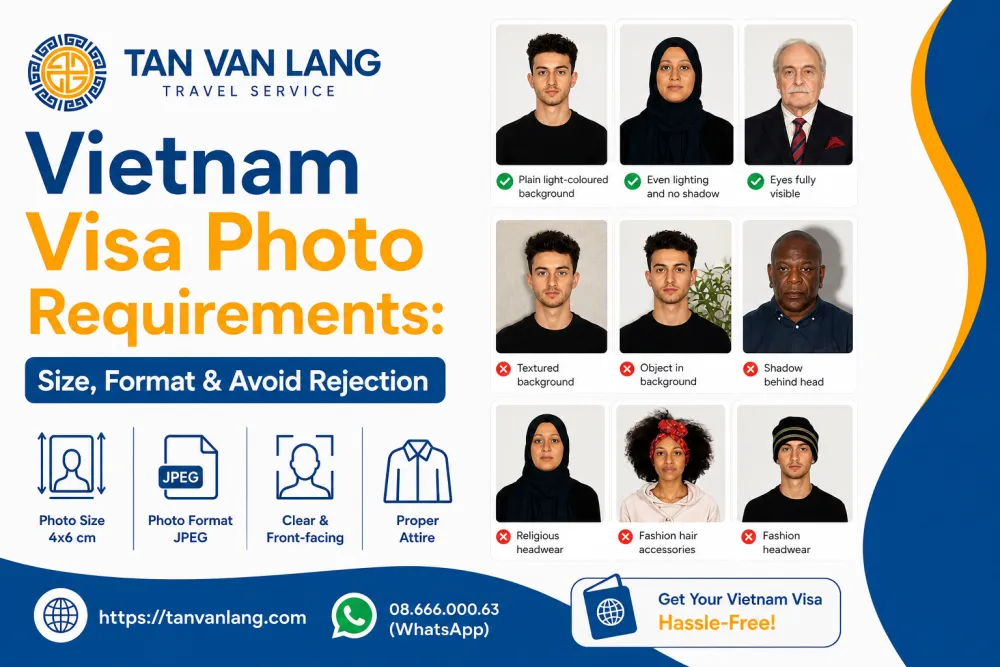
For the passport data page, the full page must be visible. Do not crop out the machine-readable zone at the bottom, because this section is frequently used to verify the applicant’s ICAO-standard passport information.
For Indian citizens with long names, initials, or different name order across documents, the passport should be the only reference. The e-visa should follow the passport, not the flight ticket, Aadhaar card, PAN card, or hotel booking.
>>> Read more: Vietnam Visa for Indians on Arrival 2026: VOA vs E-Visa [Compared]
Step-by-step Vietnam visa online application process 2026
The Vietnam e-visa application is submitted through the Vietnam e-visa official website. Applicants should be very careful with search engine ads and lookalike websites, because many third-party pages imitate official wording while charging extra service fees or collecting personal data.
The safest approach is to access the official Vietnam e-visa portal directly and avoid websites that do not clearly identify their role. If a traveler uses an agency, they should understand whether the agency is providing consultation, document review, urgent handling support, or simply redirecting to the public portal.
From our daily work with the Vietnam Immigration Department, the most common e-visa problems for Indian applicants are not caused by complex law. They usually come from typing mistakes, poor scans, wrong date format, and choosing an entry port that does not match the real travel plan.
Step 1: Access the official e-visa portal
Go to the Vietnam e-visa official website (evisa.gov.vn) or evisa.vnhub.com and select the option for foreigners applying for an electronic visa. Read the instructions carefully before entering personal information.
Applicants should avoid unofficial websites that use similar phrases such as “Vietnam visa online,” “Vietnam immigration visa,” or “urgent Vietnam e-visa” without explaining that they are private service providers.
Step 2: Upload the portrait photo and passport data page
Upload a recent portrait photo and a clear image of the Indian passport data page. Make sure the file is not blurred, dark, tilted, or partially cut off.
The portrait photo should not include glasses, hats, heavy shadows, or a busy background. The passport page should show all details, including the machine-readable lines at the bottom.
Step 3: Complete the Vietnam visa application form
Fill in the Vietnam visa application form exactly as shown in the passport. Pay special attention to full name, gender, date of birth, nationality, passport number, passport issue date, and passport expiry date.
Indian applicants should also enter the planned entry date, exit date, temporary address in Vietnam, and purpose of visit. For tourism, use the relevant tourism purpose; for business meetings, choose the closest lawful short-term business purpose available in the system.
Step 4: Choose single-entry or multiple-entry visa
Applicants must choose between a single-entry e-visa and a Vietnam multiple entry visa. A single-entry visa allows one entry into Vietnam during the approved validity period.
A multiple-entry e-visa allows the traveler to enter, leave, and re-enter Vietnam multiple times within the approved validity period. This option is useful for Indian travelers combining Vietnam with Thailand, Cambodia, Laos, Singapore, or other nearby destinations.
Step 5: Select Vietnam entry ports and exit ports
The applicant must choose the intended entry and exit ports from the list accepted by the e-visa system. E-visas can only be used at approved international airports, land border gates, and seaports.
A critical detail most applicants overlook is that the selected port should match the real arrival plan. If the e-visa lists one airport or border gate but the traveler arrives at another place, airline staff or immigration officers may refuse boarding or entry.
Step 6: Pay the Vietnam visa fee for Indians
After checking the form, proceed to online payment. The official government fee is normally 25 USD for a single-entry e-visa and 50 USD for a multiple-entry e-visa.
The Vietnam visa fee for Indians is non-refundable once paid, even if the application is rejected or the applicant makes a mistake. For this reason, applicants should review the form carefully before payment.
Step 7: Save the registration code and check the result
After submission, the system provides a registration code. Save this code immediately because it is needed to check the Vietnam E-visa processing time status and download the result.
The typical processing time is about 3-5 working days, but practical delays can happen during peak seasons, Vietnamese public holidays, system maintenance, or when an application requires additional review. Tan Van Lang usually advises Indian applicants to submit the application 7 to 40 days before the trip, depending on itinerary certainty and urgency.
Step 8: Download, print, and verify the approved e-visa
Once approved, download the e-visa and check every detail before traveling. The name, passport number, date of birth, nationality, validity period, entry type, and entry port must be correct.
Print a copy and keep a digital copy on your phone. Airlines may ask to see the e-visa before allowing boarding to Vietnam.
>>> Read more: Vietnam visa for Indians 2026: Guide, Fees & Requirements
Vietnam E-visa fees and processing time for Indians
The current official Vietnam e-visa fee is based on the type of entry selected. Indian citizens pay the same official e-visa fee schedule as other eligible foreign applicants [2].
| Visa type | Official government fee | Best for |
|---|---|---|
| Single-entry Vietnam e-visa | 25 USD | One trip to Vietnam without leaving and re-entering. |
| Multiple-entry Vietnam e-visa | 50 USD | Trips involving regional travel or repeated Vietnam entries. |
The fee is paid online through the electronic payment gateway. It is generally non-refundable if the application is refused, withdrawn, duplicated, or submitted with incorrect information.
The standard Vietnam E-visa processing time is often stated as 3-5 working days. In real practice, applicants should not treat this as a guaranteed deadline.
When should Indian citizens apply?
For a normal trip, Indian applicants should submit the application at least 7 working days before departure. For travel during Tet, public holidays, summer peak months, or large event periods, applying earlier is safer.
Tan Van Lang recommends a practical application window of 7 to 40 days before the intended travel date. Applying too late creates unnecessary pressure, while applying too early may cause problems if the itinerary, airport, hotel, or travel date changes.
What can delay the e-visa result?
Common causes of delay include:
- Blurred passport scan or portrait photo.
- Name order that does not match the passport.
- Wrong date of birth or passport number.
- Passport validity shorter than expected.
- Duplicate applications with inconsistent information.
- Payment failure or incomplete payment confirmation.
- High application volume before holidays.
- Security or immigration review by the competent authority.
For Indian passport Vietnam visa cases, we often see delays when applicants use auto-fill tools in the browser. Auto-fill can accidentally insert a wrong phone number, old passport number, or incorrect date format.
>>> Read more: How to Stay in Vietnam Long Term : All Visa Options 2026
Validity period and permitted Vietnam entry ports
A Vietnam evisa for Indian citizens can be issued for up to 90 days. The exact validity period appears on the approved e-visa and must be checked carefully before travel.
The e-visa validity period is not always the same as the number of days the traveler actually stays in Vietnam. The traveler must enter and exit within the approved validity dates.
If the e-visa is valid from 1 March to 29 May, the traveler cannot enter before 1 March and cannot remain after 29 May unless another lawful immigration solution is approved. Overstaying can lead to fines, exit delays, visa difficulties, and future immigration complications.
Single-entry vs multiple-entry Vietnam e-visa
| Option | Meaning | Suitable for |
|---|---|---|
| Single-entry e-visa | Enter Vietnam one time only. The visa ends once the traveler exits. | Simple one-country Vietnam trip. |
| Multiple-entry e-visa | Enter and exit Vietnam multiple times during the validity period. | Vietnam plus Cambodia, Laos, Thailand, Singapore, or repeated business visits. |
A multiple-entry visa is often better for travelers who are not fully sure whether they will leave Vietnam and return during the same trip. The official fee is higher, but it can prevent the need for a new application.
Major Vietnam entry ports for e-visa holders
Vietnam e-visa holders must use approved ports listed by the Vietnam immigration system. These include major international airports, many land border gates, and selected seaports.
Common airport entry points include:
- Noi Bai International Airport in Hanoi.
- Tan Son Nhat International Airport in Ho Chi Minh City.
- Da Nang International Airport in Da Nang.
- Cam Ranh International Airport in Khanh Hoa.
- Phu Quoc International Airport in Kien Giang.
- Cat Bi International Airport in Hai Phong.
- Phu Bai International Airport in Hue.
- Can Tho International Airport in Can Tho.
Common land and sea entry points may also be available, depending on the official e-visa port list at the time of application. Applicants should always select the port from the official system instead of relying on old travel blogs or outdated agency pages.
>>> Read more: Vietnam Visa Fees & Cost 2026: Updated E-visa, Embassy [Full List]
Important tips for a successful Vietnam evisa for Indian application
A Vietnam visa for Indians may look simple online, but immigration approval depends on accuracy. The applicant is responsible for the information submitted, even when a friend, travel agent, or hotel staff helps fill out the form.
Match the name with the passport ICAO line
The full name should follow the passport data page and machine-readable zone. This is especially important for Indian names with initials, multiple given names, no surname, or different spelling across documents.
If the passport shows the surname and given name separately, the e-visa form should reflect that structure as closely as the system allows. Do not shorten the name for convenience.
Check the passport number manually
Indian passport numbers usually combine letters and digits. Applicants sometimes confuse “0” and “O” or mistype one digit when copying from a low-quality scan.
Before payment, compare the passport number on the form with the actual passport at least twice. A visa with a wrong passport number may not be accepted for boarding or entry.
Use the correct date format
Date format errors are common in Vietnam visa online applications. Indian applicants are used to day-month-year formats, while online systems may display fields differently.
Check date of birth, passport issue date, passport expiry date, entry date, and exit date carefully. A wrong date can result in refusal or an approved visa that does not cover the real travel period.
Do not choose the wrong entry port
If your flight lands at Tan Son Nhat International Airport, your e-visa should not list a land border gate. If your itinerary changes after approval, review whether the new entry point is still compatible with the issued visa.
Entry port consistency is a serious practical issue. Airlines often check visa details before boarding, and they may refuse passengers if the visa does not match the planned arrival route.
Avoid scam sites and misleading “official” pages
Search results may show paid ads or private websites that look similar to an official immigration portal. Some sites charge high fees, promise unrealistic approval, or provide no meaningful review service.
The Vietnam e-visa official website is the safest place for direct submission. If using a consultant, choose a transparent agency that explains service fees separately from government fees.
Declare temporary residence after arrival
Foreigners staying in Vietnam must have their temporary residence declared with the local authority. In most hotel stays, the hotel handles this process based on the guest’s passport and visa information.
If an Indian citizen stays at a private apartment, friend’s house, company residence, or long-term rental, the host or accommodation manager should complete the temporary residence declaration. Failure to register temporary residence can create problems during visa extension, exit procedures, police checks, or later immigration applications.
Do not work in Vietnam on a tourist e-visa
A Vietnam tourist visa for Indians or tourism-purpose e-visa does not authorize employment in Vietnam. Short meetings, sightseeing, and personal travel are different from working for a Vietnam-based employer or receiving salary for work performed in Vietnam.
If the purpose is employment, technical service, long-term assignment, or local salary, the applicant should seek advice on work permit, work permit exemption, business visa sponsorship, or temporary residence card options.
>>> Read more: Vietnam Airport Fast Track Service 2026 – Skip the Lines, Save Time
Practical checklist before submitting a Vietnam e-visa application
Use this checklist before paying the government fee:
| Item to check | Why it matters |
|---|---|
| Passport validity | The passport should remain valid for at least six months from arrival. |
| Full name | Must match the Indian passport exactly. |
| Passport number | One wrong letter or digit can make the visa unusable. |
| Date of birth | Date format mistakes are common. |
| Portrait photo | No glasses, clear face, plain background. |
| Passport scan | Full data page and ICAO line must be readable. |
| Entry date | Visa validity must start on or before the real arrival date. |
| Exit date | Must cover the full intended stay. |
| Entry port | Must match the real airport, land border, or seaport. |
| Visa type | Single entry or multiple entry must match the itinerary. |
| Payment | Government fee is non-refundable. |
This checklist is simple, but it prevents most avoidable e-visa mistakes. Applicants should never rush the final review screen.
>>> Read more: Vietnam visa service : Fast & secure solution for your trip 2026
Frequently asked questions
How long can an Indian citizen stay in Vietnam with an e-visa?
An Indian citizen can receive a Vietnam e-visa valid for up to 90 days. The exact permitted period is shown on the approved e-visa, so the traveler must follow the validity dates printed on the document.The traveler must leave Vietnam before or on the expiry date unless a lawful extension, new visa, or other immigration solution is approved. Overstay penalties can affect future Vietnam visa applications.
Is it possible for Indians to get a multiple-entry e-visa for Vietnam?
Yes. Indian citizens can apply for a Vietnam multiple entry visa through the e-visa system if they need to enter and exit Vietnam more than once within the approved validity period.This is useful for travelers who plan to visit Vietnam, then travel to another country, and return to Vietnam again. It is also useful for regional business trips.
What is the total cost of a Vietnam e-visa for Indian tourists?
The official government fee is 25 USD for a single-entry e-visa and 50 USD for a multiple-entry e-visa. This fee is paid online and is generally non-refundable.If an applicant uses a private agency, consultation or service fees may be added separately. Travelers should always distinguish between the official government fee and the agency service fee.
How many days does it take to process a Vietnam e-visa for Indian applicants?
The standard processing time is usually about 3 working days. This does not always include weekends, Vietnamese public holidays, payment delays, or cases requiring extra review.For safer planning, Indian applicants should apply at least 7 working days before departure. During busy travel periods, applying earlier is better.
Can Indian citizens enter Vietnam through any border gate with an e-visa?
No. E-visa holders must enter and exit through ports accepted by the Vietnam e-visa system. These include approved international airports, land border gates, and seaports.Applicants should select the correct entry and exit ports during the application. If the travel route changes, they should check whether the issued e-visa still matches the new plan.
What should I do if there is an error on my issued Vietnam e-visa?
If the issued e-visa contains an error, do not assume it can be corrected at the airport. In many cases, the applicant may need to submit a new application or seek urgent support before departure.Errors in name, passport number, date of birth, nationality, validity dates, or entry type can prevent boarding or entry. Contact Tan Van Lang as early as possible if your trip is close.
Is the Vietnam e-visa fee refundable if my application is not approved?
No. The official e-visa fee is generally non-refundable if the application is rejected or submitted incorrectly.This is why applicants should review every field carefully before payment. Professional document checking can be helpful when the trip is urgent or the case is not straightforward.
Conclusion
The Vietnam evisa for Indian citizens is one of the most convenient ways for Indian passport holders to visit Vietnam for short-term tourism or business purposes. It is online, relatively fast, and available for up to 90 days with single-entry or multiple-entry options.
The main risk is not the online system itself. The real risk is submitting inaccurate information, using a poor-quality photo, choosing the wrong entry port, or applying through a misleading website.
Tan Van Lang has supported foreign visitors and Vietnam-based sponsors since 2003. If you want your Vietnam visa for Indians case reviewed by an experienced team before submission, or if your application is urgent, rejected, or contains an error, contact Tan Van Lang for clear and practical guidance.
Contact +84.866.149.199 (WhatsApp) now!