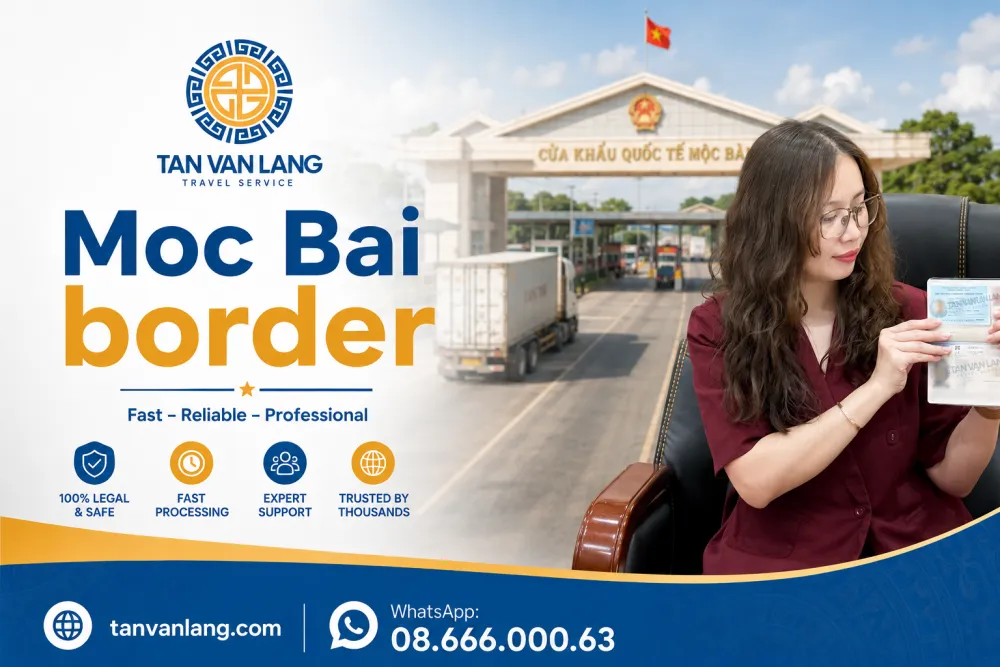
The Moc Bai border is the most convenient land crossing for travelers moving between Ho Chi Minh City and Cambodia, especially those planning a Vietnam visa run through Bavet. To re-enter Vietnam at Moc Bai, foreigners must hold a valid visa or e-visa with the correct entry port, valid dates, and matching passport details.
Overview of the Moc Bai international border gate
The Moc Bai border is the main land gateway in Southern Vietnam connecting Tay Ninh Province with Bavet in Svay Rieng Province, Cambodia. On the Vietnam side, it is commonly called Moc Bai International Border Gate. On the Cambodia side, the corresponding checkpoint is the Bavet border gate.
For travelers based in Ho Chi Minh City, Moc Bai is popular because it is relatively close, accessible by road, and accepted for Vietnam e-visa entry and exit when the visa details are correct. This is why the phrase “Moc Bai border run” is often used by foreigners who need to leave Vietnam and re-enter with a new visa.
Moc Bai is not only an immigration checkpoint. It is also part of the broader Tay Ninh border crossing and trade area, with customs activity, transport services, duty-free shopping, and cross-border tourism between Vietnam and Cambodia.
From our practical advisory work, we see three main groups of travelers using the Moc Bai border:
| Traveler type | Main purpose | Key risk |
|---|---|---|
| Tourists | Travel between Vietnam and Cambodia | Wrong visa type or wrong entry port |
| Foreigners staying in Vietnam | Vietnam visa run or re-entry with a new e-visa | Re-entering before the new visa is valid |
| Business travelers | Land crossing for meetings or regional trips | Missing business visa, invitation or temporary residence compliance |
The most important point is simple: The Moc Bai border is convenient, but it is still an official immigration checkpoint. Travelers should treat the process as a legal entry and exit procedure, not as a casual bus stop.
>>> Read more: Immigration Office HCMC 2026: Address, Hours & Services Guide
Moc Bai border status and why visa runners use this crossing
The Moc Bai border status can change depending on public holidays, traffic volume, immigration workload, special security instructions, or policy updates. Before traveling, you should confirm that the border is operating normally and that your visa allows entry through Moc Bai.
Many foreigners choose Moc Bai for a Vietnam visa run because the route from Ho Chi Minh City is shorter than most other land borders. It is also easier to organize same-day transportation compared with border gates in Central or Northern Vietnam.
A typical Moc Bai visa run has one legal purpose: the traveler exits Vietnam, enters Cambodia, then re-enters Vietnam using a valid new visa or visa exemption, depending on eligibility. For many nationalities, the most common document is now a Vietnam e-visa.
According to the latest 2025 regulations in Law No. 23/2023/QH15 and the current Vietnam e-visa system, Vietnam may issue e-visas with validity of up to 90 days, for single or multiple entry, depending on what is approved. Travelers should not assume they automatically receive 90 days. The exact validity, number of entries, and permitted entry point are stated on the approved visa.
Based on our advisory experience, the most common problems at Moc Bai are not caused by the border itself. They are usually caused by one of these errors:
- The traveler selected the wrong Vietnam entry port on the e-visa application.
- The e-visa is approved, but the validity date has not started yet.
- The traveler has a single-entry e-visa and already used it.
- The passport number or name on the visa does not match the passport.
- The traveler overstayed before attempting the visa run.
- The traveler relies on unofficial fixers instead of checking the legal requirements.
A good Moc Bai border run starts before the traveler leaves Ho Chi Minh City. The visa should be checked line by line before departure.
>>> Read more: Single Entry Vietnam Visa 2026: Fees, Validity & How to Apply
How to travel from Ho Chi Minh City to Moc Bai border
The route from Ho Chi Minh City to Moc Bai is one of the most common overland routes for travelers going to Cambodia or doing a Vietnam visa run. The road normally follows National Highway 22 toward Tay Ninh.
Travel time depends on departure point, traffic, weather, and the queue at immigration. A realistic estimate from central Ho Chi Minh City to the Moc Bai border is around 2.5 to 4 hours by road.
Moc Bai bus from Ho Chi Minh City
The Moc Bai bus is the most affordable option. Many travelers use public or intercity bus services from Ho Chi Minh City toward Moc Bai or Phnom Penh.
Bus Route 703 is commonly mentioned for the Ho Chi Minh City to Moc Bai route. Travelers should check the latest pickup point, schedule, ticket price and operating status before departure, because local bus operations may change.
The main advantage of taking a bus is cost. The main disadvantage is flexibility. If immigration takes longer than expected, or if your visa has an issue, you may not have full control over the return schedule.
Private car to Moc Bai
A private car is suitable for families, business travelers, and people who want a more predictable schedule. It is also useful when carrying luggage or when the traveler needs support during the day.
For a visa run, a private car can wait near the border area while the traveler completes exit and re-entry procedures. The cost is higher than a bus, but it reduces the stress of finding transport after returning to Vietnam.
Visa run limousine services
Specialized visa run limousine services are popular among foreigners living in Ho Chi Minh City. These services usually include pickup, transport to Moc Bai, waiting time, and return to Ho Chi Minh City.
From our practical experience, the quality of these services varies. Travelers should choose a provider that clearly explains what is included, what is not included, and whether they provide legal visa checking before the trip.
Do not choose a transport provider only because they promise a “guaranteed border run.” No transport company can legally guarantee immigration approval if the visa is wrong, the passport is invalid, or the traveler has an unresolved overstay issue.
Direct bus to Phnom Penh through Bavet
Travelers who are not doing a same-day visa run may take a direct bus from Ho Chi Minh City to Phnom Penh. These buses normally cross at Moc Bai on the Vietnam side and Bavet on the Cambodia side.
This option is convenient for tourists who want to continue into Cambodia. It is less suitable for travelers who only want to exit and immediately re-enter Vietnam, unless the bus company clearly allows enough time for the full process.

>>> Read more: How to check Vietnam visa status ? Update 2026
Step-by-step guide for a Moc Bai visa run
A Moc Bai border run should be planned in a strict sequence. The biggest mistake is going to the border first and checking the visa later.
Step 1: Check your current Vietnam stay status
Before leaving for Moc Bai, confirm your current permitted stay in Vietnam. Look at your latest entry stamp, e-visa, visa sticker, temporary residence card, or visa exemption stamp.
If you have overstayed, do not attempt a casual visa run without professional advice. Overstay cases may involve fines, delay, written explanation, or other immigration handling before exit.
Tan Van Lang often advises clients to handle overstay and document errors first, instead of creating a more complicated record at the border.
Step 2: Prepare your new Vietnam visa or e-visa Moc Bai entry
If you plan to re-enter Vietnam through Moc Bai, your new visa must allow entry at Moc Bai. For e-visa users, this means the approved e-visa should show Moc Bai International Border Gate or the correct official Moc Bai landport name as the entry port, depending on the format used by the system.
Do not rely only on the application you submitted. You must check the final approved e-visa PDF or official result.
For E-Visa Moc Bai cases, check these details:
| Item to check | Why it matters |
|---|---|
| Full name | Must match passport identity page |
| Passport number | One wrong digit can cause refusal |
| Date of birth | Must match passport |
| Nationality | Must match passport used for travel |
| Entry date | You cannot enter before the visa validity starts |
| Expiry date | You must leave or extend before expiry |
| Entry type | Single or multiple entry affects future travel |
| Entry port | Must match Moc Bai if entering through Moc Bai |
From our practical advisory work, wrong entry port is one of the most expensive small mistakes. It can turn a simple same-day border run into a refused entry problem.
Step 3: Travel from Ho Chi Minh City to Moc Bai
Leave early in the morning. This gives you enough time for traffic, queues, Cambodia entry procedures, and Vietnam re-entry.
You should avoid arriving late in the afternoon. Even if the gate area appears open, immigration processing may become limited close to closing time.
Carry printed copies of key documents. Digital copies are useful, but printed documents help when phone battery, internet, or screen readability becomes an issue.
Step 4: Exit Vietnam at Vietnam immigration Moc Bai
At the Vietnam immigration Moc Bai exit counter, present your passport and current stay document. Immigration officers will check whether you are allowed to leave Vietnam.
If there is no overstay, no restriction, and no document issue, the officer will stamp your exit. After that, you proceed toward the Cambodia side.
Do not lose your passport or documents during the short walking or transfer distance between the two checkpoints. Border areas can be busy, and many travelers are approached by brokers, money changers or transport agents.
Step 5: Enter Cambodia at Bavet border gate
At the Bavet border gate, you must complete Cambodia entry formalities. Depending on nationality and current Cambodia policy, you may need a Cambodia visa on arrival, Cambodia e-visa, or may qualify for visa exemption.
For many tourists, the Cambodia tourist visa allows a stay of 30 days. A Cambodia visa fee may apply, and travelers should prepare clean USD notes if paying at the border.
Fees and procedures can change. If you are doing a visa run and do not intend to travel deeper into Cambodia, still remember that you are legally entering Cambodia. Your Cambodia entry and exit should be properly stamped or recorded.
Step 6: Exit Cambodia
After entering Cambodia, same-day visa runners usually proceed to exit Cambodia. This may involve walking to the exit control area or following local instructions inside the Bavet checkpoint.
Do not skip Cambodia exit procedures. If your passport does not show a proper Cambodia exit record, it may affect future travel or re-entry processing.
Travelers should also avoid paying unofficial “border crossing fee” requests without understanding what the payment is for. Official visa fees and service fees should be distinguished from unofficial facilitation requests.
Step 7: Re-enter Vietnam through Moc Bai
Return to the Vietnam side and present your passport with your new visa, e-visa, visa exemption eligibility, temporary residence card, or other valid entry document.
For Vietnam e-visa holders, the officer will check the e-visa validity, passport details, entry port and entry type. If approved, you will receive a new entry stamp or admission record.
Before leaving the counter area, check your stamp or entry record carefully. Make sure the permitted stay date matches the visa or entry basis.
Step 8: Return to Ho Chi Minh City
After completing re-entry, you can return to Ho Chi Minh City by bus, car, limousine, or other arranged transport. Keep all visa and entry documents because hotels, landlords, employers, or immigration authorities may need them for temporary residence declaration.
Temporary residence is often ignored by travelers after a visa run. In Vietnam, accommodation providers are responsible for declaring foreign guests’ temporary residence, but foreigners should still make sure the place they stay can complete this process properly.
>>> Read more: How is Vietnam to live ? Real costs, lifestyle 2026
Required documents for crossing the Moc Bai – Bavet border
The required documents depend on your nationality, visa type, travel purpose and direction of travel. The checklist below focuses on foreign travelers entering or re-entering Vietnam through Moc Bai.
| Document | Needed for | Expert note |
|---|---|---|
| Passport | All travelers | Should be valid for at least 6 months in most cases |
| Current Vietnam visa or stay proof | Exiting Vietnam | Needed to confirm lawful stay before exit |
| New Vietnam e-visa or visa | Re-entering Vietnam | Must be valid and show correct entry conditions |
| Cambodia visa or visa exemption | Entering Cambodia | Check nationality-specific rules before travel |
| Passport photo | Cambodia visa on arrival, if required | Carry at least one spare photo |
| Cash in USD/VND | Fees and transport | Prepare small notes and avoid relying only on cards |
| Printed visa copies | Vietnam and Cambodia checks | Strongly recommended |
| Hotel or address in Vietnam | Temporary residence and entry questions | Use a real address where you will stay |
| Onward ticket or itinerary | Sometimes requested | Useful for tourists and short-term visitors |
If your Vietnam e-visa has the wrong Moc Bai entry port, do not assume the officer will “adjust it at the border.” In many cases, travelers must apply for a corrected visa or choose the entry port stated on the approved visa.
For business travelers, a tourist e-visa may not be suitable if the actual purpose is employment, contract execution or long-term business activity. Vietnam immigration compliance depends not only on the visa label, but also on the real purpose of stay.
>>> Read more: Vietnam visa rejection reasons and how to avoid 2026
Updated fees and processing times at Moc Bai border
The cost of a Moc Bai border crossing depends on transport, Cambodia visa requirements, Vietnam visa type, and whether you use professional support. There is no single fixed cost for every traveler.
Common cost items
| Cost item | Typical situation | Notes |
|---|---|---|
| Transport from Ho Chi Minh City to Moc Bai | Bus, private car, limousine | Price varies by provider and service level |
| Vietnam e-visa fee | If applying online | Pay through the official Vietnam e-visa system or trusted support provider |
| Cambodia visa fee | If visa is required | Tourist visa fee is commonly quoted in USD, but travelers should verify current Cambodia rules |
| Printing and photos | If needed | Small cost but useful |
| Food and waiting time | Same-day trip | Bring water and basic necessities |
| Professional visa support | If using an agency | Useful for complex cases, entry port checks, overstay, business purpose or urgent review |
Vietnam visa stamping fee and e-visa distinction
Travelers sometimes confuse Vietnam e-visa fees, visa stamping fees, and agency service fees. These are not the same.
A Vietnam e-visa is applied for online before arrival and is not the same as traditional visa-on-arrival arrangements. Vietnam visa-on-arrival approval letters are mainly associated with airport entry and specific approved cases, not a general solution for land border entry at Moc Bai.
If someone offers to “sell a Vietnam visa at Moc Bai” without an official basis, treat it as a serious warning sign. Vietnam entry permission should be arranged before reaching the border.
Cambodia visa fee and Bavet processing
Many travelers report Cambodia tourist visa charges in USD at land borders, but exact payment handling may vary depending on nationality, visa type, and Cambodia’s current policy. Use official Cambodia channels where possible and prepare cash in acceptable condition if paying at Bavet.
Do not hand over your passport to unknown individuals outside official counters. If you use a service provider, make sure you know the company name, contact number, inclusions and total fee before the trip.
>>> Read more: How to Stay in Vietnam Long Term : All Visa Options 2026
Important tips to avoid scams and long queues
The Moc Bai border is busy because it serves tourists, traders, bus passengers, casino visitors, and visa runners. Busy border areas often attract unofficial helpers.
Avoid unofficial fixers
Some people may approach travelers with offers such as “quick stamp,” “no need to queue,” “visa guaranteed,” or “special border crossing fee.” These claims can create legal and financial risk.
From our practical experience, the safest rule is to keep your passport with you unless you are submitting it at an official counter or to a verified service representative. Never allow a stranger to carry your passport away from your view.
If your visa has a real problem, a fixer at the gate usually cannot lawfully solve it. Proper solutions often require correction, re-application, overstay handling, or direct immigration guidance.
Arrive early
For a same-day visa run, early arrival is the simplest way to reduce risk. Morning departure gives you time to handle unexpected queues, document checking, and Cambodia procedures.
Avoid planning a border run close to a flight, important meeting, or visa expiry deadline. A border run should not be treated as a last-minute rescue plan.
Check public holidays
Vietnamese and Cambodian holidays can affect traffic and border workload. Before traveling, check whether your planned date falls near Tet, Cambodia’s Khmer New Year, major national holidays, or long weekends.
Even when the gate remains open, queues and transport availability can change sharply during holiday periods.
Use the official e-visa website carefully
Scam sites and imitation visa websites are a real concern. Some websites look official but charge high fees, provide poor support, or submit incorrect information.
When applying alone, use the official Vietnam e-visa system and review every field before payment. When using an agency, choose a registered and experienced company that checks your passport, visa history, entry port, travel plan and risk factors.
Tan Van Lang has handled tens of thousands of complex visa cases since 2003. Our role is not only to submit forms, but also to identify risks before clients reach the border.
Confirm the Moc Bai border map and route
A Moc Bai border map is useful for understanding the route from Ho Chi Minh City, the location of the Vietnam checkpoint, the Bavet side, and nearby transport points. Still, map apps may not show the exact walking flow inside immigration areas.
Follow official signs and officer instructions once you arrive. Do not wander into restricted customs or cargo-processing areas.
Do not carry items for strangers
Never carry bags, parcels, documents, tobacco, alcohol, medicine, electronics, or sealed items for people you do not know. Border areas are strictly controlled, and “helping someone” can create criminal or customs risk.
This warning applies even if the person appears friendly, claims to be in a hurry, or offers payment.
>>> Read more: Vietnam Airport Fast Track Service 2026 – Skip the Lines, Save Time
Moc Bai duty-free zone and what travelers should know
The Moc Bai duty-free zone is often mentioned in travel guides because the border area has shopping facilities and cross-border commercial activity. However, visa runners should not let shopping distract them from immigration timing.
Duty-free allowances, product restrictions, and purchase rules may depend on traveler status and current customs policy. Alcohol, tobacco, high-value goods and commercial quantities can be restricted.
If your purpose is a visa run, complete your exit and re-entry procedure first. Shopping should be secondary.
>>> Read more: Vietnam visa service : Fast & secure solution for your trip 2026
Moc Bai visa extension versus visa run
Many travelers use the phrase “Moc Bai visa extension,” but it is important to separate two different concepts.
A visa extension usually means extending your permitted stay inside Vietnam without leaving the country, if eligible and if the policy allows it. A visa run means leaving Vietnam and re-entering with a new visa or entry basis.
The Moc Bai border is used for visa runs, not for automatically extending a visa at the counter. Immigration officers at the border process entry and exit. They do not simply extend your current visa because you arrived at Moc Bai.
If you need to stay longer in Vietnam, the best option depends on your nationality, visa type, sponsor, overstay status, purpose of stay and timing. Tan Van Lang can assess whether you should apply for a new e-visa, handle an extension route, change visa purpose, or prepare for a legal exit and re-entry.
Temporary residence after entering Vietnam through Moc Bai
After entering Vietnam through Moc Bai, foreigners must comply with temporary residence rules. In practice, hotels usually declare temporary residence for guests. If you stay in an apartment, private house, company accommodation or with friends, the host or landlord should complete the required declaration.
This matters because visa compliance is not finished at the border. A foreigner may have a valid entry stamp but still face problems later if temporary residence records are missing or inconsistent.
From our advisory work, temporary residence records are especially important for:
- Visa extension or renewal cases
- Temporary residence card applications
- Work permit and business visa cases
- Police checks at accommodation
- Long-term stay planning in Vietnam
Keep copies of your latest visa, entry stamp and accommodation address. If you change accommodation, make sure the new place can declare your stay properly.
Professional checklist before a Moc Bai border run
Before leaving Ho Chi Minh City, review this checklist carefully.
| Question | Safe answer before departure |
|---|---|
| Is my passport valid and undamaged? | Yes |
| Is my current Vietnam stay still legal? | Yes |
| Do I have an approved new Vietnam visa or valid exemption basis? | Yes |
| Does my e-visa show Moc Bai as the entry port if entering through Moc Bai? | Yes |
| Has the visa validity date already started? | Yes |
| Do I understand whether my visa is single or multiple entry? | Yes |
| Do I need a Cambodia visa? | Checked |
| Do I have cash, printed documents and transport arranged? | Yes |
| Do I have enough time before the border slows or closes? | Yes |
| Do I know where I will stay after re-entering Vietnam? | Yes |
If any answer is “not sure,” check before you travel. Border mistakes are harder to fix once you are already between two countries.
Frequently asked questions
What are the operating hours of the Moc Bai international border gate?
Can I use a Vietnam e-visa to enter through Moc Bai?
How much does a Cambodia visa on arrival cost at the Bavet border?
Is it possible to complete a Moc Bai visa run in a single day?
Do I need to book a bus in advance for the Moc Bai border crossing?
Are there any duty-free shops currently operating at Moc Bai?
What should I do if my Vietnam e-visa has the wrong entry port name?
Conclusion
The Moc Bai border is a practical and popular route for Vietnam-Cambodia travel, especially for foreigners based in Ho Chi Minh City. It is also one of the most frequently used crossings for Vietnam visa run cases.
Still, convenience does not remove legal requirements. Your passport, Vietnam e-visa, Cambodia entry status, Moc Bai entry port, temporary residence record and travel timing must all be aligned.
If you are unsure about your visa, do not wait until you reach the border. Contact Tan Van Lang before your trip so our consultants can check your documents and recommend the safest legal route for entering or re-entering Vietnam through Moc Bai.
Contact +84.866.149.199 (WhatsApp) now!