Vietnam Visa for Filipino Citizens 2026: Visa-Free 21 Days
Last update:
Filipino citizens traveling to Vietnam benefit from a 21-day visa-free entry under the ASEAN bilateral agreement, no application or fee required for short stays. For trips exceeding 21 days, a Vietnam e-visa is mandatory and can be obtained entirely online through the Vietnam Immigration Department‘s official portal in as little as 3 business days.
The most commonly used visa types for Filipinos are the DL tourist visa and TT family visit visa, each valid for up to 90 days with single or multiple-entry options available. Key requirements include a valid Philippine passport with at least 6 months remaining, a compliant passport photo, and accurate personal details matching the passport exactly.
Vietnam Visa Consulting Services for Foreigners
Established in 2003, backed by 20+ years of experience – Trusted with over 10,000 successful Vietnam visa consultations.
Our Vietnam Visa Consulting Success for Foreign Clients
Visa exemption policy for Filipino passport holders
Filipino citizens are currently entitled to visa-free entry into Vietnam for stays of up to 21 days under the bilateral visa exemption agreement between the two ASEAN member states [1]. This policy applies to all holders of a valid Philippine passport, regardless of travel purpose (whether tourism, family visits, or short business engagements). No prior application, no pre-approval letter, and no visa fee is required under this arrangement.
To qualify for visa-free entry, your Filipino passport must retain at least six months of validity beyond your intended date of departure from Vietnam. Immigration officers at Noi Bai International Airport and Tan Son Nhat International Airport routinely verify this requirement alongside your onward or return ticket. Presenting a confirmed return flight is a standard expectation during the entry inspection process.
Key conditions for the 21-day visa-free entry for Filipinos:
Valid Philippine passport with at least 6 months of remaining validity
Return or onward ticket confirming departure within 21 days of arrival
Proof of sufficient funds for the duration of your stay
No prior overstay record or immigration violation in Vietnam
The exemption period is fixed and cannot be extended from within the country
From our practical experience, the 21-day visa-free period begins on the date of entry and cannot be extended or renewed. Filipino nationals who attempt a “visa run” exiting and immediately re-entering Vietnam to reset their exemption, risk being denied re-entry by the Vietnam Immigration Department if officers determine a pattern of circumventing the visa system.
When Filipino citizens need a visa for longer stays
Any intended stay in Vietnam exceeding 21 days requires a valid visa. The Vietnam e-visa (electronic visa) is currently the most accessible option for Filipino citizens planning trips of up to 90 days, and it is processed entirely online through the Vietnam Immigration Department’s official portal — eliminating the need to appear at an embassy or consulate in person.
The following table outlines the principal Vietnam visa types available to Filipino passport holders:
Visa type
Purpose / Applicant
Validity period
Tourist visa (DL)
Foreigners visiting Vietnam for tourism or sightseeing
Up to 90 days, single or multiple entry
Family visit visa (TT)
Foreigners visiting relatives residing in Vietnam
Up to 90 days (e-visa) or 180 days (dependent of work permit holder)
Foreigners enrolled in Vietnamese educational institutions
Duration tied to enrollment certificate
From our practical experience, Filipino travelers most frequently apply for the DL tourist visa and TT family visit visa categories. Business visitors and investors should consider the DN or DT visa types respectively, as these offer considerably greater flexibility and longer authorized stay periods.
Tan Van Lang provides reliable Vietnam visa services backed by over 20 years of professional experience.
The Vietnam e-visa system, administered directly by the Vietnam Immigration Department, accepts applications entirely online. Preparing complete and accurate documentation is the single most decisive factor in avoiding processing delays or outright rejections. Incomplete submissions — particularly mismatched names, low-resolution photos, or expired passport scans — account for the majority of avoidable e-visa refusals encountered by Filipino applicants in our experience.
Standard documents required for a Vietnam e-visa:
A valid Philippine passport with at least 6 months of validity remaining from the date of intended entry
A digital passport photo (4 x 6 cm, white background, full face clearly visible, taken within the previous 6 months)
A completed online e-visa application form, filled in exactly as your passport details read
A valid email address to receive the official e-visa confirmation document
An international credit or debit card to pay the government processing fee
Additional documents for the family visit visa (TT) category:
Proof of relationship with your Vietnamese contact — birth certificate, marriage certificate, or equivalent documentation
A copy of the Vietnamese national’s ID card or household registration book (so ho khau)
Documents issued outside Vietnam must be officially notarized and translated into Vietnamese before submission
Additional documents for the business visa (DN) via approval letter:
Certified copies of business registration and investment license of the sponsoring Vietnamese company
Form NA16 — Registration of company seal and authorized signature
Digital signature token (USB token) of the sponsoring company
Authorization letter or introduction paper issued by the sponsoring Vietnamese entity
National ID of the company representative filing the application
A firm warning that our advisors raise with every Filipino client: Only use the official Vietnam Immigration Department website or a licensed, reputable immigration firm such as Tan Van Lang when submitting your application and payment. Fraudulent websites that closely mimic the official e-visa portal are widespread, have caused serious financial harm, and in some cases have resulted in applicants arriving at Tan Son Nhat International Airport with counterfeit approval documents. Always verify the URL before entering any personal data or card details.
We support foreigners with accurate consultation and compliant visa solutions for Vietnam.
How to apply for a Vietnam e-visa from the Philippines
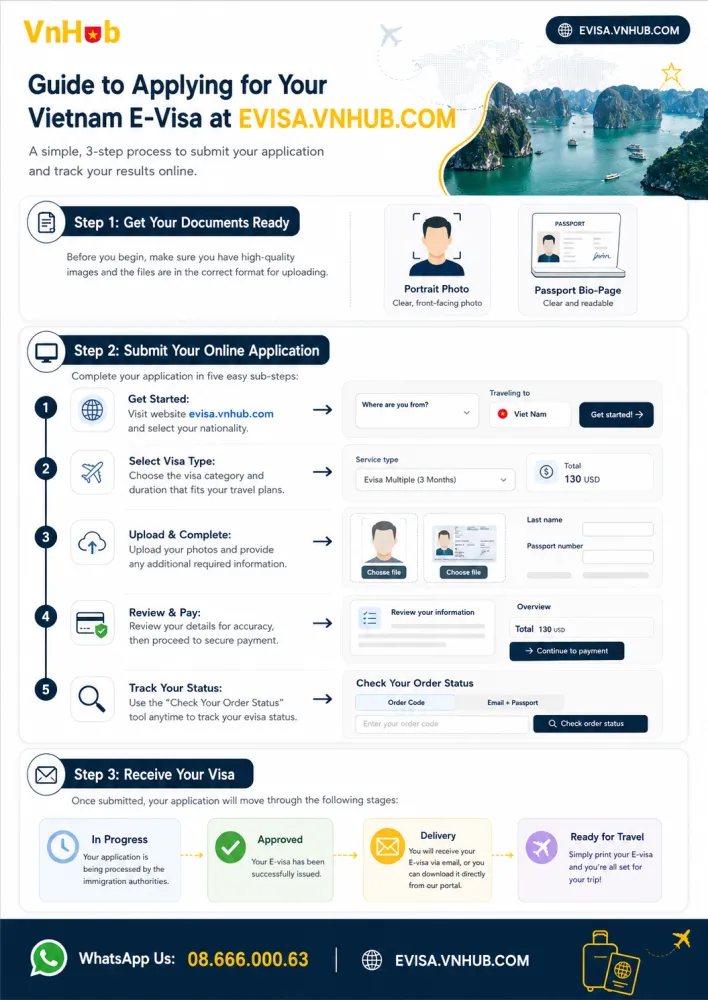
The e-visa application is designed to be completed entirely online. Filipino citizens can apply from any location with a stable internet connection, and the process takes approximately 15 to 30 minutes when all documents are prepared in advance.
Step-by-step application process:
Access the official portal: Visit the Vietnam Immigration Department’s official e-visa website. Cross-check the domain URL carefully against the official government source before proceeding or you can use a trusted visa service provider such as Tan Van Lang via https://evisa.vnhub.com/ to handle the submission on your behalf.
Select your nationality: Choose “Philippines” from the nationality dropdown to confirm your Philippine passport status and trigger the correct application fields.
Complete the application form: Enter all personal details exactly as they appear in your passport. Any discrepancy including a single character difference in your name will cause your application to be rejected at the border gate.
Upload the required documents: Submit a clear scan of your passport biographical page and your passport photo. Ensure images meet the specified size and quality requirements before uploading.
Pay the government fee: Complete payment using a valid international credit or debit card. Retain the payment confirmation number for your records.
Receive and print your e-visa: Upon approval, the Vietnam Immigration Department will issue your e-visa as a PDF to your registered email address. Print a physical copy; presenting a digital version on a phone screen is not accepted at all entry ports.
Present at the immigration checkpoint: Hand your printed e-visa and Philippine passport to the immigration officer at the designated entry port listed on your document.
Based on our advisory experience, your approved e-visa specifies a single designated entry port. If you enter through Noi Bai International Airport but your e-visa was issued for Tan Son Nhat International Airport you will be denied entry. Confirm your exact travel itinerary and entry airport before submitting your application, and contact the Vietnam Immigration Department or a licensed service provider immediately if your flight plans change after approval.
The Vietnam Immigration Department officially states a processing window of 3 business days for e-visa applications. Approvals for standard tourist applications often arrive within 24 hours, though this is not guaranteed.
From our practical advisory work, our team advises Filipino clients to apply at least 7 to 10 business days before their departure date to accommodate any unexpected delays, document correction requests, or high-volume processing periods.
Visa on arrival remains a valid entry option for Filipinos arriving at international airports in Vietnam.
The process requires obtaining an official approval letter in advance through a licensed Vietnamese immigration agency or sponsoring company, presenting this letter upon landing, and paying the stamping fee directly at the airport immigration counter. Visa on arrival is strictly limited to international airports — it is not available at land border crossings or seaport entry points.
The e-visa government processing fee is paid separately online during the application. Any service fees charged by third-party providers, including Tan Van Lang, are fully disclosed upfront before any commitment is made — transparency on costs is a practice we have maintained since our founding in 2003.
Temporary residence registration
A requirement that many Filipino visitors are unaware of: upon entering Vietnam, you are legally obligated to register your temporary residence (khai bao tam tru) with local public security authorities within 24 hours of arrival at your accommodation address.
Hotels, guesthouses, and serviced apartments handle this registration automatically on your behalf. However, if you stay with a Vietnamese family member or in a private rental, the Vietnamese household head must submit the registration form to the local ward police station. Failure to register can result in administrative fines and may create complications when you depart the country or apply for a visa extension.
Airlines and flight routes from the Philippines to Vietnam
Several carriers operate direct routes connecting the Philippines and Vietnam, offering Filipino travelers a range of price points and schedules:
Vietnam Airlines: Direct flights from Manila, Cebu, Clark, and Davao to Hanoi, Ho Chi Minh City, Da Nang, and Nha Trang
Philippine Airlines: Direct service from Manila, Cebu, and Davao to Hanoi, Ho Chi Minh City, and Da Nang
Cebu Pacific: Budget routes from Manila, Cebu, Clark, and Davao to major Vietnamese cities
AirAsia Philippines: Direct flights from Manila to Hanoi and Ho Chi Minh City
Connecting itineraries via Kuala Lumpur, Singapore, and Bangkok are available through Malaysia Airlines, Singapore Airlines, and Thai Airways respectively.
Working hours: Monday to Friday, 9:00 AM – 4:30 PM (excluding public holidays in Vietnam and the Philippines)
Frequently asked questions
Do Filipino citizens need a visa to visit Vietnam?
Filipino citizens do not need a visa for stays of up to 21 days under the current bilateral exemption agreement. For stays exceeding 21 days, or for specific purposes such as business, employment, or family sponsorship, a valid Vietnam visa — most commonly the e-visa — is required. The appropriate visa category is determined by your intended purpose of stay and duration.
How long can Filipino citizens stay in Vietnam visa-free?
Under the current bilateral agreement, Filipino passport holders may stay in Vietnam for a maximum of 21 days without a visa. This period is fixed from the date of entry and cannot be extended while you remain inside the country. Travelers wishing to stay beyond 21 days must secure a valid Vietnam visa prior to arrival.
What documents are needed for a Vietnam e-visa?
The standard requirements are a valid Philippine passport (minimum 6 months validity), a digital passport photo (4 x 6 cm, white background), and a completed online application form. Depending on your visa category — tourist, family visit, or business — additional supporting documents may be required, as detailed in the requirements section above.
How long does Vietnam e-visa processing take for Filipino citizens?
The official processing period is 3 business days. In practice, approvals for straightforward tourist applications often arrive within 24 to 48 hours. To build in adequate buffer time, applying 7 to 10 days before your travel date is the safest approach.
How much does a Vietnam visa cost for Filipino citizens?
The government e-visa processing fee is charged at a standard rate applicable to all nationalities. For visa on arrival, stamping fees at the airport range from USD 25 for a single-entry one-month visa to USD 135 for a 12-month multiple-entry visa. All official fees are subject to revision by the Vietnam Immigration Department, so verifying the current schedule before applying is always recommended.
Can Filipino citizens get a visa on arrival in Vietnam?
Yes. Filipino citizens are eligible for visa on arrival at major international airports including Noi Bai International Airport in Hanoi and Tan Son Nhat International Airport in Ho Chi Minh City. A pre-approved approval letter from the Vietnam Immigration Department is required and must be arranged through a licensed immigration service provider before departure. This option is not applicable at land or sea border crossings.
What happens if a Filipino citizen overstays in Vietnam?
Overstaying a Vietnam visa or visa-free entry period is a formal immigration violation. Consequences include mandatory fines, enforced departure, and immigration bans that can range from several months to multiple years depending on the severity and duration of the overstay. The Vietnam Immigration Department has significantly increased enforcement across all entry points in recent years, and individuals with a prior overstay record face heightened scrutiny — and potential blacklisting — on all subsequent entry attempts.
Why Filipino travelers choose Tan Van Lang
Since 2003, Tan Van Lang has operated as one of Vietnam’s most established immigration service firms, building a track record of successful outcomes across tens of thousands of complex visa and residency cases.



![Vietnam Visa Fees & Cost: Updated E-visa, Embassy [Full List]](https://tanvanlang.com/wp-content/uploads/2025/10/vietnam-visa-fees-cost-300x200.webp)