Japanese citizens can enter Vietnam without a visa for stays of up to 45 days under Vietnam’s current visa exemption policy, making short-term travel straightforward for most ordinary Japanese passport holders.
For stays beyond 45 days, the Vietnam e-visa (available online for up to 90 days as a single-entry or multiple-entry option) is the most practical solution. Those entering for work, investment, or expert assignments must use the correct visa category such as an LD visa, DT visa, or business visa backed by a Vietnamese sponsor.
Vietnam Visa Consulting Services for Foreigners
Established in 2003, backed by 20+ years of experience – Trusted with over 10,000 successful Vietnam visa consultations.
Our Vietnam Visa Consulting Success for Foreign Clients
Visa exemption policy for Japanese passport holders
Japanese nationals holding an ordinary Japanese passport are currently entitled to enter Vietnam visa-free for up to 45 days per visit [1]. This exemption applies regardless of the port of entry whether by air through Noi Bai International Airport or Tan Son Nhat International Airport, or by approved land and sea borders.
This makes Vietnam one of the most accessible destinations in Southeast Asia for travelers from Japan. The policy covers tourism, family visits, short business meetings, and preliminary site inspections.
That said, the exemption has specific conditions that travelers must meet to avoid problems at immigration.
What Japanese travelers should prepare at entry
Even when no Vietnam visa is required, immigration officers at Noi Bai International Airport, Tan Son Nhat International Airport, or other ports of entry may still review your travel conditions. Based on our practical advisory work with hundreds of Japanese arrivals each year, you should prepare the following before departure:
- A valid Japanese passport with at least 6 months of validity beyond your intended arrival date
- Sufficient blank pages in your passport for entry and exit stamps
- A clear travel itinerary consistent with your stated purpose
- Accommodation details for your stay in Vietnam
- Return or onward ticket as evidence of planned departure
A mismatch between your hotel booking, arrival airport, and stated travel purpose is one of the most common reasons Japanese travelers face unnecessary questioning at immigration. Consistency across all documents matters far more than many travelers assume.
What the 45-day exemption does not cover
The visa-free entry benefit is broad but not unlimited. Japanese citizens should not rely on the 45-day exemption in the following situations:
- Performing any form of paid work for a Vietnamese company or foreign-invested enterprise
- Conducting long-term expert assignments or internal transfers
- Running investment activities that require formal investor status under Vietnamese law
- Engaging in journalism, broadcasting, or other regulated professional activities
- Planning a stay that exceeds 45 days
If your actual purpose falls into any of the above categories, the correct route is a visa or residence structure that matches your real activity, not visa-free entry used as a workaround.
>>> Read more: Vietnam visa/E-visa for Japanese citizens 2026: Guide, Fees & Requirements
When Japanese citizens need a visa for longer stays
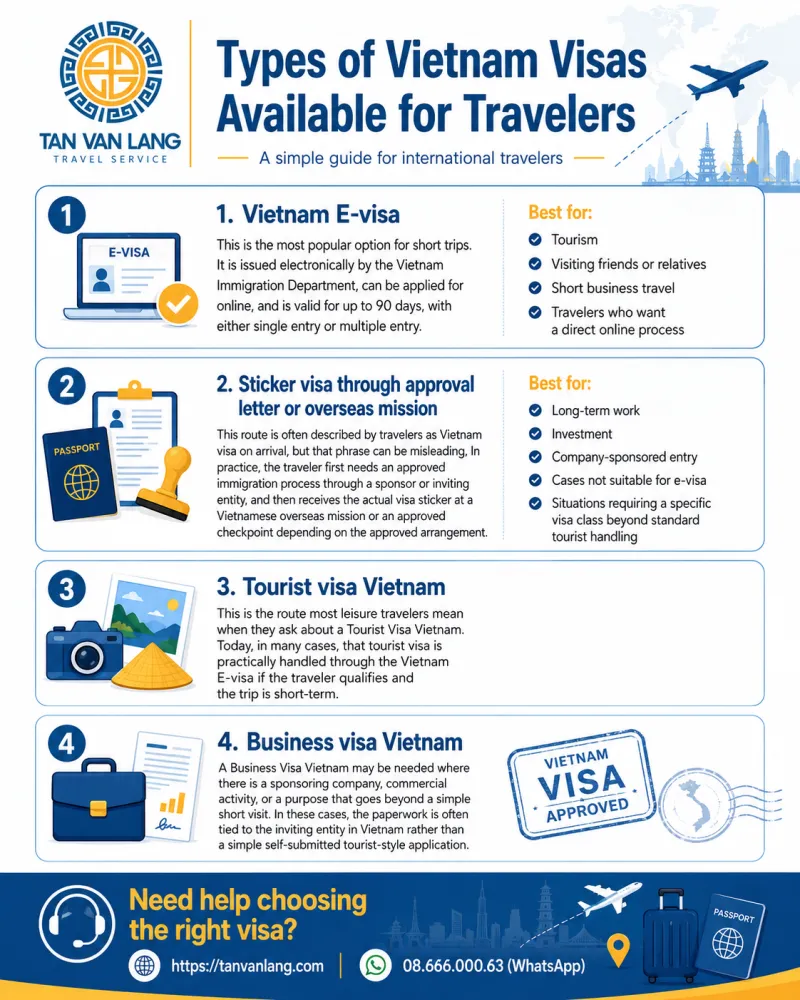
When the 45-day visa exemption is not sufficient, Japanese citizens have several options depending on the purpose and length of stay. Understanding which route applies to your situation is where most errors occur.
Vietnam e-visa for stays up to 90 days
The Vietnam e-visa is currently the most practical option for Japanese citizens who need more than 45 days. Issued through the official online portal at evisa.gov.vn or thithucdientu.gov.vn, it can be approved for up to 90 days with either a single-entry visa or multiple-entry visa structure.
From our case handling experience across thousands of Japanese applications, the e-visa suits the following situations well:
- Trips exceeding 45 days for tourism or family visits
- Business visitors making multiple short trips within a 90-day window
- Travelers who prefer to have their visa confirmed before arriving
- Applicants who want to avoid the airport stamping queue associated with visa on arrival
Business visa and long-term routes for Japanese nationals
When the purpose extends beyond standard tourism or short-term business, Japanese nationals need a visa category that matches the actual nature of their activities. The table below summarizes the main options:
| Entry option | Main purpose | Maximum stay | Key note |
|---|---|---|---|
| Visa exemption | Tourism, family visit, short business activities | 45 days | No visa required if entry conditions are met |
| E-visa | Tourism, business, short-term visits | Up to 90 days | Single-entry or multiple-entry visa available |
| Business visa | Sponsored commercial activities | Depends on approval | Requires a sponsoring entity in Vietnam |
| LD visa | Employment and labor-based entry | Aligned with work permit | Must be paired with a valid work permit or exemption |
| DT visa | Investment-related residence | Depends on approved category | Tied to capital structure and legal investor status |
| Temporary residence card | Long-term labor, investment, or family residence | 1–3 years typically | Reduces need for repeated visa renewals |
A critical point that many Japanese companies miss: Sending employees into Vietnam on tourist-style entry for roles that actually require a work permit creates serious legal exposure for both the employee and the company. The immigration file and the labor or investment file must be aligned from the beginning.
>>> Read more: Apply for a temporary residence card for Japanese citizens 2026: Guide, Fees, Requirements
Documents required for Vietnam e-visa application
The entry requirements for a Vietnam e-visa are straightforward for most Japanese passport holders, but small errors in document preparation cause a disproportionate number of delays and rejections.
Based on the official application framework and our direct experience reviewing Japanese e-visa files, a standard application requires:
- Passport biodata page scan: Clear, high-resolution, showing all printed details without obstruction
- Portrait photo: Meeting the government’s format requirements for size, background, and framing
- Valid email address: Used for receiving the approval notification and e-visa document
- Expected entry date: Should be realistic and leave processing buffer time
- Intended port of entry: Noi Bai International Airport, Tan Son Nhat International Airport, or another approved checkpoint
- Accommodation details: Hotel address or a valid contact point in Vietnam
One entry requirements detail that frequently causes problems: the port of entry declared in the application must match your actual arrival point. If your travel plan changes after approval, the mismatch may only be discovered at airline check-in or at immigration. Changing the entry port after approval requires re-applying in most cases.
>>> Read more: Do I need a visa if I have a temporary residence permit in Vietnam 2026?
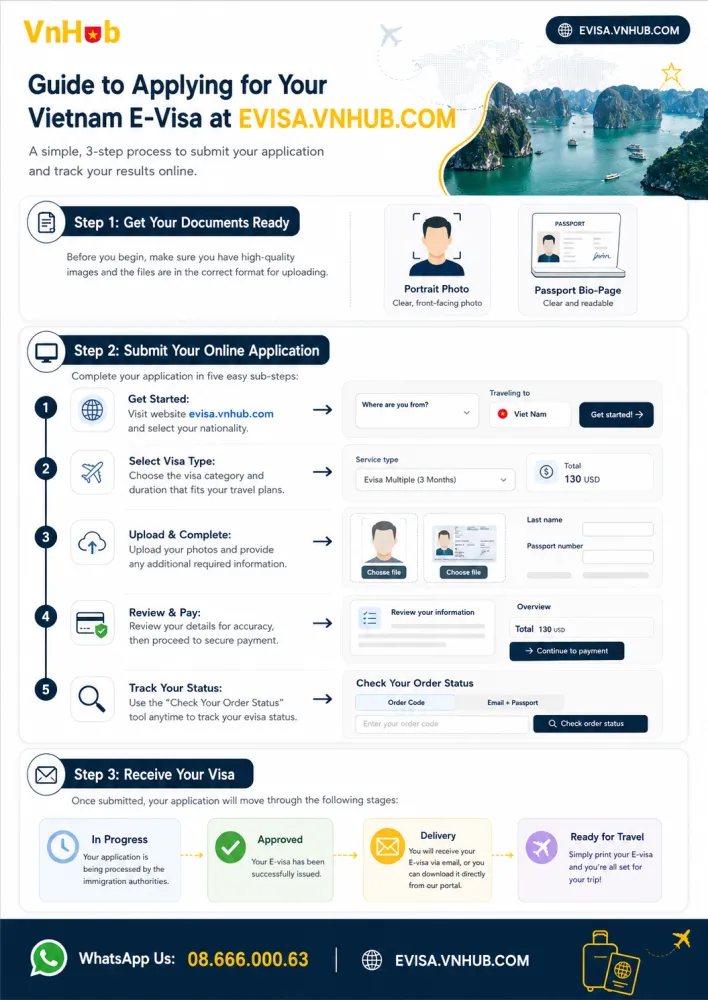
How to apply for a Vietnam e-visa from Japan
The online application process for a Vietnam e-visa is designed for self-service. Japanese citizens can complete the entire process from Tokyo, Osaka, Nagoya, Fukuoka, or any other location with internet access, no visit to the Vietnam Consulate or Embassy is needed for the standard e-visa route.
Step-by-step application process
| Step | Action | Practical note |
|---|---|---|
| 1 | Access the official government portal | Use evisa.gov.vn or thithucdientu.gov.vn only |
| 2 | Complete the online application form | Enter all details exactly as they appear in your Japanese passport |
| 3 | Upload passport scan and portrait photo | Poor image quality is the leading cause of delay |
| 4 | Pay the government visa fee | Fees are non-refundable if the application is refused |
| 5 | Wait for processing | Standard handling is around 3 working days for complete files |
| 6 | Download and print the approved e-visa | Keep both digital and printed copies |
| 7 | Enter Vietnam through your declared port | Ensure all details match your passport exactly |
Scam site warning for Japanese applicants
The scam-site problem deserves direct attention. Numerous websites mimic the appearance of the official Vietnam e-visa portal and appear in paid advertising results. Some charge significantly higher fees than the government rate. Others collect personal data and payment without delivering a legitimate approval.
Before paying any fee, confirm that you are using one of the two official government domains. If you use a professional visa service, that service should clearly identify itself as a private assistance company not misrepresent itself as a government portal.
With over 20 years of experience since 2003, Tan Van Lang has assisted Japanese citizens in avoiding exactly this type of problem. Verifying the authenticity of the platform before submitting your passport information is not optional.
Common mistakes Japanese applicants make
From reviewing Japanese e-visa files regularly, these are the most frequent errors:
- Incorrect name order — Japanese passports present names in a different order than some Latin-script systems expect
- Typing mismatches between the passport and the application form
- Wrong passport expiry date entered
- Low-resolution or incorrectly cropped passport scan
- Portrait photo that does not meet format requirements
- Booking non-refundable flights before the e-visa approval is confirmed
>>> Read more: Vietnam Visa Photo Requirements 2026: Size, Format & Avoid Rejection
Processing time and fees for Japanese applicants
Official e-visa fees
The standard government fees for Vietnam e-visa as currently published are [2]:
| Visa type | Government fee |
|---|---|
| Single-entry visa | USD 25 |
| Multiple-entry visa | USD 50 |
These are the government fees only. If you use a professional visa service, service fees are charged separately and should be disclosed transparently before you proceed.
Processing time in practice
The official standard processing time is approximately 3 working days for complete, correctly submitted files. In our practical experience handling Japanese applications, the realistic turnaround is often slightly longer when you account for:
- Photo or document quality issues requiring resubmission
- Name-order discrepancies triggering a manual review
- Public holidays in Vietnam that interrupt the processing calendar
- Peak travel periods when application volumes are higher
The practical recommendation is to apply at least 7–10 calendar days before your planned entry date. Booking flights or accommodation before the e-visa is confirmed in your hands introduces unnecessary risk.
Embassy and consulate option for Japanese citizens
Japanese citizens can also apply through Vietnamese diplomatic missions in Japan. The Embassy of Vietnam in Tokyo handles most applications from the Tokyo region, while the Vietnam Consulate General in Osaka serves applicants in western Japan.
The embassy route is appropriate when your file requires a sponsored visa category not available through the e-visa system, when you have been specifically instructed to use the consular route, or when your case involves documentation that benefits from direct consular review.
Consular procedures can vary between offices. Appointment systems, document checklists, and fee collection methods may differ between the Tokyo Embassy and the Osaka Consulate. Confirming current requirements directly with the relevant office before preparing your file is strongly advised.
>>> Read more: Vietnam Airport Fast Track Service 2026 – Skip the Lines, Save Time
Frequently asked questions
Do Japanese citizens need a visa to visit Vietnam?
How long can Japanese citizens stay in Vietnam visa-free?
What documents are needed for a Vietnam e-visa?
How long does Vietnam e-visa processing take for Japanese citizens?
How much does a Vietnam visa cost for Japanese citizens?
Can Japanese citizens get a visa on arrival in Vietnam?
What happens if a Japanese citizen overstays in Vietnam?
Why working with Tan Van Lang makes a difference
The structure of a Vietnam immigration file matters far more than many applicants expect. Choosing the wrong visa type, declaring the wrong entry port, or submitting a document set that does not align with your actual purpose creates delays that could have been avoided at the planning stage.
With over 20 years of hands-on visa and immigration practice since 2003, Tan Van Lang has handled tens of thousands of complex visa cases for Japanese citizens, Japanese companies, and Vietnam-based sponsors. Our work spans standard e-visa reviews, business visa structures, LD visa compliance, DT visa investor routes, work permit strategy, and temporary residence card applications.
We support:
- Vietnam e-visa review and urgent handling
- Business visa setup with Vietnamese sponsoring entities
- Work permit and expert entry structure for Japanese employees
- LD visa and long-stay compliance planning
- DT visa and investor residence pathway
- Temporary residence card applications aligned with labor or investment files
- Entry planning for travelers departing from Tokyo, Osaka, Nagoya, Fukuoka, and other cities in Japan
Contact +84.866.149.199 (WhatsApp) now!