Staying in Vietnam long term is completely achievable if you choose the right legal pathway. Most expats succeed through one of four options: the Temporary Residence Card (TRC), work permit + TRC, investor visa, or marriage/dependent visa. Each option comes with its own requirements, benefits, and long-term stability. Understanding these routes clearly will help you plan your stay with confidence and avoid unnecessary immigration issues.
Understanding the Basics of Vietnam’s Long-Term Visa Policies
Vietnam has evolved significantly in its approach to foreign residents over the past few years. Gone are the days when visa runs every month were your only option. Today, the Vietnamese government offers several legitimate pathways for foreigners who want to establish a more permanent presence in the country.
First, let’s clarify what we mean by “long term.” For most people, this means staying beyond the typical tourist visa period of 15 to 90 days. The good news is that Vietnam recognizes different categories of long-term visitors, each with specific visa types designed to match your circumstances.
Since August 15, 2023, Vietnam has expanded its electronic visa program substantially. Citizens from all countries can now apply for e-visas valid for up to 90 days with single or multiple entries through any of the 42 international border gates. Additionally, 13 countries including the UK, Germany, France, Italy, Spain, Denmark, Norway, Sweden, Finland, Russia, Belarus, Japan, and South Korea now enjoy visa exemption for up to 45 days instead of the previous 15 days.
However, if your goal is to truly settle in Vietnam for months or years, you’ll need to look beyond tourist visas and e-visas. The key to living in Vietnam for expats lies in obtaining either a temporary residence card Vietnam or a specific long-term visa category that aligns with your purpose for staying.
The Vietnamese immigration system categorizes long-term stays based on your activities: working, doing business, investing, studying, or joining family members. Each category has its own requirements, benefits, and limitations. Understanding these distinctions will save you time, money, and potential headaches down the road.
The Most Popular Ways for Expats to Stay in Vietnam Long Term
Based on our years of consulting experience, we’ve identified four primary pathways that cover the vast majority of cases. Let’s examine each one in detail.
Option 1: The Temporary Residence Card (TRC) Explained
The temporary residence card Vietnam, commonly abbreviated as TRC, represents one of the most sought-after documents for foreigners planning an extended stay. Unlike regular visas that require renewals every few months, a TRC allows you to reside in Vietnam for periods ranging from six months to five years, depending on your eligibility.
TRC Service – Tân Văn Lang supports expats in obtaining a Temporary Residence Card (TRC) with fast processing, clear guidance, and full sponsorship assistance.
So, how to get TRC in Vietnam? The process typically involves sponsorship. You’ll need a Vietnamese entity – whether a company, an educational institution, or a family member who is a Vietnamese citizen – to sponsor your application. The sponsor submits your documentation to the local immigration department, which then evaluates your case.
The TRC offers several advantages. Once approved, you don’t need to worry about frequent visa renewals or border runs. You can open local bank accounts more easily, sign long-term rental agreements, and generally integrate into Vietnamese society with fewer administrative hurdles. Many expats find that having a TRC makes daily life significantly smoother.
However, the TRC isn’t automatic. You must meet specific criteria depending on your sponsorship category. Common routes include employment with a Vietnamese company, marriage to a Vietnamese national, or enrollment in a Vietnamese educational institution. Each route has its own documentation requirements and processing timeline.
The validity period of your TRC depends on your circumstances. Work-related TRCs often match your employment contract length, up to two years at a time, with the possibility of renewal. Marriage-based TRCs can extend up to three years. Investor-related TRCs may reach five years for substantial investments.
Option 2: Securing a Vietnam Work Permit and TRC
For those coming to Vietnam for employment, the combination of a Vietnam work permit and temporary residence card forms the foundation of your legal stay. This is arguably the most common pathway for western expats who relocate to Vietnam.
The process begins with your employer. Vietnamese law requires that foreign workers obtain a work permit before starting employment, with some exceptions for short-term assignments or specific professional categories. Your employer acts as your sponsor throughout the process.
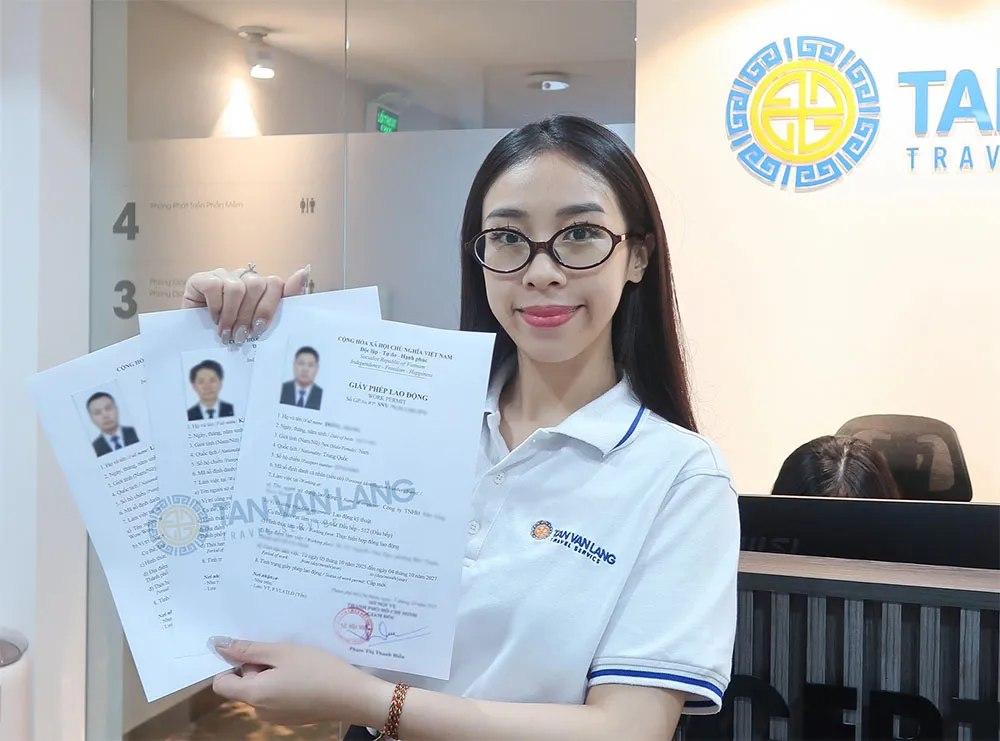
Work Permit + TRC – We handle your Vietnam work permit and TRC end-to-end, ensuring legal employment status and long-term stay without paperwork stress.
Here’s what you typically need to provide:
A valid passport with at least six months validity Your original degree certificates and transcripts, properly notarized and legalized Police clearance certificate from your home country, issued within the past six months Health certificate from a Vietnamese medical facility Passport-sized photographs meeting Vietnamese standards Employment contract with the Vietnamese company
The documentation requirements can feel overwhelming, especially the notarization and legalization process for educational certificates. Many countries require apostille stamps or embassy authentication. This is where having experienced guidance makes a substantial difference. At Tân Văn Lang, we regularly help clients navigate these bureaucratic requirements efficiently.
Once your work permit is approved—a process that typically takes four to six weeks—you can then apply for your TRC. The work permit itself is valid for up to two years and can be renewed if you continue working with the same employer or find new employment.
One important consideration: your work permit ties you to a specific employer and job position. If you change jobs, you’ll need to cancel your existing permit and apply for a new one with your new employer. This transition period requires careful planning to avoid gaps in your legal status.
Option 3: The Vietnam Investor Visa (DT1, DT2, DT3, DT4)
Vietnam welcomes foreign investment, and the Vietnam investor visa reflects this policy. If you have the financial means and business acumen, establishing a company or making a significant investment in Vietnam can provide you with a clear pathway to long-term residence.
Investor Visa (DT1–DT4) – Tân Văn Lang provides complete support for setting up your business or investment in Vietnam to secure a long-term investor visa and TRC.
The investor visa category breaks down into several subcategories based on your investment type and amount:
DT1 visa is for investors who establish a company in Vietnam and make substantial capital contributions. This route requires registering a legal business entity with the appropriate Vietnamese authorities.
DT2 visa applies to corporate representatives or branch office managers of foreign companies operating in Vietnam.
DT3 visa is designated for investors in specific economic zones or industrial parks with preferential investment policies.
DT4 visa covers other investment-related activities approved by Vietnamese authorities.
The investment threshold varies depending on your business sector and location. Generally, you should expect to invest at least several hundred million Vietnamese dong, though exact amounts depend on your specific business plan and the regulatory environment of your industry.
One major advantage of the investor route is that it can lead to a TRC valid for up to five years, particularly for substantial investments that create jobs and contribute to the local economy. This represents the longest single period of authorized stay available to most foreigners.
The process involves several steps. First, you’ll need to develop a viable business plan and complete the business registration process with the Department of Planning and Investment. Next, you’ll need to secure appropriate premises for your business operations.
Finally, once your business is legally established and your investment verified, you can apply for your investor visa and subsequent TRC.
Keep in mind that maintaining your investor visa requires actually operating your business. Authorities expect to see genuine business activities, tax filings, and compliance with Vietnamese commercial law. This isn’t a passive arrangement—you need to actively manage or be involved in your investment.
Option 4: The Vietnam Marriage Visa or Dependent Visa (TT Visa)
If you’re married to a Vietnamese citizen or have Vietnamese children, the Vietnam marriage visa, officially known as the TT visa, offers a straightforward path to long-term residence. This category recognizes the importance of family unity and provides considerable flexibility.
The TT visa is notably easier to obtain compared to work permits or investor visas because you don’t need employment sponsorship or significant capital investment. Your Vietnamese spouse serves as your sponsor, and the primary requirement is proving your legitimate marital relationship.
With a marriage-based TRC, you can stay in Vietnam for up to three years per authorization, with straightforward renewal processes. Many expats appreciate that this visa type doesn’t restrict your activities in Vietnam—you’re free to work, start a business, or simply enjoy retirement, though working still requires appropriate work authorization.
One significant benefit is that after holding a marriage-based TRC for three consecutive years, you may become eligible to apply for a Vietnam permanent residence card, commonly called the PRC. The permanent residence card represents the highest level of residence authorization for foreigners, providing nearly all the rights of Vietnamese citizens except voting and certain other civic privileges.
>>> Read more:Vietnam visa fees: Updated costs & What travelers should expect 2026
What About Visa Extensions and Visa Runs?
Let’s address the question many first-time visitors ask: can I just keep extending my tourist visa or doing visa runs? The short answer is technically yes, but practically speaking, it’s not a sustainable long-term strategy.
Extending visa in Vietnam is certainly possible. If you enter on a tourist visa and decide you want to stay longer, you can apply for an extension through authorized visa agencies while you’re in the country. Each extension typically adds 30 days to 3 months to your stay, depending on the type.
However, there are several limitations to consider. First, visa extensions cost more than obtaining a new visa from outside Vietnam. Second, there’s a limit to how many times you can extend—you can’t extend indefinitely. Third, living on continuous tourist visa extensions doesn’t provide the stability or legal standing that a proper long-term visa offers.
Visa runs—leaving Vietnam briefly and returning on a new visa—used to be a common workaround. Some expats would fly to nearby countries like Thailand, Cambodia, or Singapore, spend a night or two, then return to Vietnam on a fresh tourist visa. While this remains technically possible, Vietnamese immigration authorities have become increasingly skeptical of frequent visa runs.
If immigration officers notice a pattern of repeated entries on tourist visas over many months, they may question your true purpose for being in Vietnam. They could deny entry, issue warnings, or flag your passport for additional scrutiny. The uncertainty and stress simply aren’t worth it when legitimate long-term visa options exist.
Our advice at Tân Văn Lang is always the same: if you’re serious about staying in Vietnam beyond a few months, invest the time and effort to obtain proper long-term authorization. The peace of mind and practical benefits far outweigh the initial paperwork.
For those who need immediate short-term flexibility while preparing long-term visa applications, strategic use of the 90-day e-visa with multiple entries can provide breathing room. However, this should serve as a transitional solution, not a permanent strategy.
Comparing the Pros and Cons of Each Long-Term Stay Option
Choosing the right pathway depends on your personal circumstances. Let’s break down the key advantages and challenges of each option to help you decide.
Category
Pros
Cons
Temporary Residence Card Through Employment
Provides stable legal status tied to genuine employment.
Simplifies banking, housing, and daily administrative tasks.
Renewable as long as employment continues.
Your employer handles much of the bureaucratic burden.
Requires finding a Vietnamese employer willing to sponsor you.
Limited to your specific job position.
Changing employers means starting the process again.
Requires extensive documentation including notarized educational certificates.
Vietnam Work Permit and TRC
Clear legal framework designed for foreign workers.
Up to two-year validity periods.
Creates a pathway to longer-term residence.
Widely understood by authorities and employers.
Significant upfront paperwork.
Can take four to six weeks to process.
Some professions face additional restrictions.
Requires medical examination and police clearance.
Investor Visa Route
Longest potential TRC validity up to five years.
Complete control over your activities.
No employer dependency.
Can create income through your business.
May lead to permanent residence faster.
Requires substantial capital investment.
Ongoing business management responsibilities.
Complex registration and compliance requirements.
Financial risk if business doesn’t succeed.
Marriage Visa (TT Visa)
Simplest documentation compared to other routes.
Three-year TRC validity.
No restrictions on activities in Vietnam.
Clear path to permanent residence after three years.
No employment or investment requirements.
Requires legitimate marriage to Vietnamese national.
Must maintain genuine marital relationship.
Extensive documentation to prove relationship authenticity.
Vietnam Business Visa (DN Visa)
For those who don’t fit the above categories, the Vietnam business visa options offer additional flexibility.
DN visas are designed for business activities, trade, investment scouting, and similar commercial purposes.
While not typically as long-term as the options above, DN visas can be issued for up to 12 months with multiple entries.
May serve as stepping stones to more permanent arrangements.
Here’s a clear breakdown of typical requirements and costs for each visa type:
Visa Type
Validity Period
Key Documents Required
Approximate Fees
Tourist Visa (C1)
30 days, single entry
Passport, photo, application form
$25-50 (varies by method)
E-Visa
Up to 90 days, single/multiple entry
Passport scan, photo, online application
$25
Business Visa (DN)
Up to 12 months, multiple entry
Passport, sponsor letter, application form
$50-135 depending on duration
Work Permit
Up to 24 months
Degree certificates, police clearance, health certificate, employment contract, photos
$150-200 processing fee
TRC (Work-based)
6 months to 2 years
Work permit, temporary residence application, photos, sponsor documents
$50-100
TRC (Marriage-based)
Up to 3 years
Marriage certificate, spouse’s ID, household registration, police clearance, health certificate
$50-100
Investor Visa (DT)
12 months, renewable
Business registration, investment verification, sponsor letter
$50-135 initial visa
TRC (Investment-based)
Up to 5 years
Investment documentation, business license, financial statements
$100-150
Note: Fees are approximate and subject to change. Additional service fees may apply if using visa agencies. Processing through Vietnamese embassies may have different fee structures [1]
What is the easiest way to stay in Vietnam long term?
For most people, the easiest path is through employment with a Vietnamese company that sponsors your work permit and TRC, assuming you have relevant qualifications and job opportunities available.
Can I stay in Vietnam long term without a job?
Yes, through the investor visa route by establishing your own business, or through a marriage visa if you have a Vietnamese spouse. Retirees may also explore business ownership as an option.
How much money do I need to invest for an investor visa?
Investment requirements vary by business sector and location, but generally expect to invest at least 3-5 billion VND or more for most business types to qualify for long-term residence benefits.
Is it possible to get a digital nomad visa for Vietnam?
Vietnam doesn’t currently offer a specific digital nomad visa category. Remote workers typically use business visas or establish Vietnamese companies to obtain legal long-term status.
What is the difference between a temporary residence card (TRC) and a permanent residence card (PRC)?
A TRC is valid for fixed periods (6 months to 5 years) and requires renewal. A PRC is essentially permanent, doesn’t require renewal, and provides nearly the same rights as Vietnamese citizenship.
How long can I stay in Vietnam with a temporary residence card?
TRC validity ranges from 6 months to 5 years depending on your category. Work-based TRCs typically last 1-2 years, marriage-based up to 3 years, and investment-based up to 5 years.
What happens if I cannot get a long-term visa before my current one expires?
You should begin your long-term visa application well before expiry. If timing is tight, you can extend your current tourist visa for 1-3 months while processing your long-term application, though extensions cost more than new visas obtained from outside Vietnam.
Understanding Vietnam visa options and choosing the right pathway requires careful consideration of your circumstances, goals, and resources. At Tân Văn Lang, we’ve helped hundreds of expats successfully navigate these processes, from initial consultation through final approval. Whether you’re pursuing a work permit, exploring investment opportunities, or applying for family-based residence, having experienced guidance ensures you avoid common pitfalls and maximize your chances of approval.
The key to success with any long-term visa application is thorough preparation, accurate documentation, and patience with the administrative process. Start planning early, gather your documents systematically, and don’t hesitate to seek professional assistance when needed. With the right approach, your dream of living in Vietnam for expats can become a comfortable, legal reality.
Tốt nghiệp chuyên ngành quản trị kinh doanh và du lịch (MKU). Sau khi tốt nghiệp, Tôi đã có 6 năm kinh nghiệm về Dịch vụ tư vấn Tour và visa xuất cảnh, 6 năm kinh nghiệm về dịch vụ tư vấn thủ tục cho người nước ngoài.
Tôi đã tư vấn cho hơn 10.000 người Việt Nam có nhu cầu du lịch nước ngoài với tỷ lệ thành công 99%.






 Vietnam visa service in Da Nang 2026
  Vietnam visa service in Hanoi 2026
  Vietnam visa service in Ho Chi Minh City 2026
  Expat living in Vietnam visa: A detailed guide for foreigners 2026
  Do I need work permit or visa Vietnam? A detailed guide for foreigners 2026
  Differences of Work permit vs work visa Vietnam 2026
 4.800+ Followers